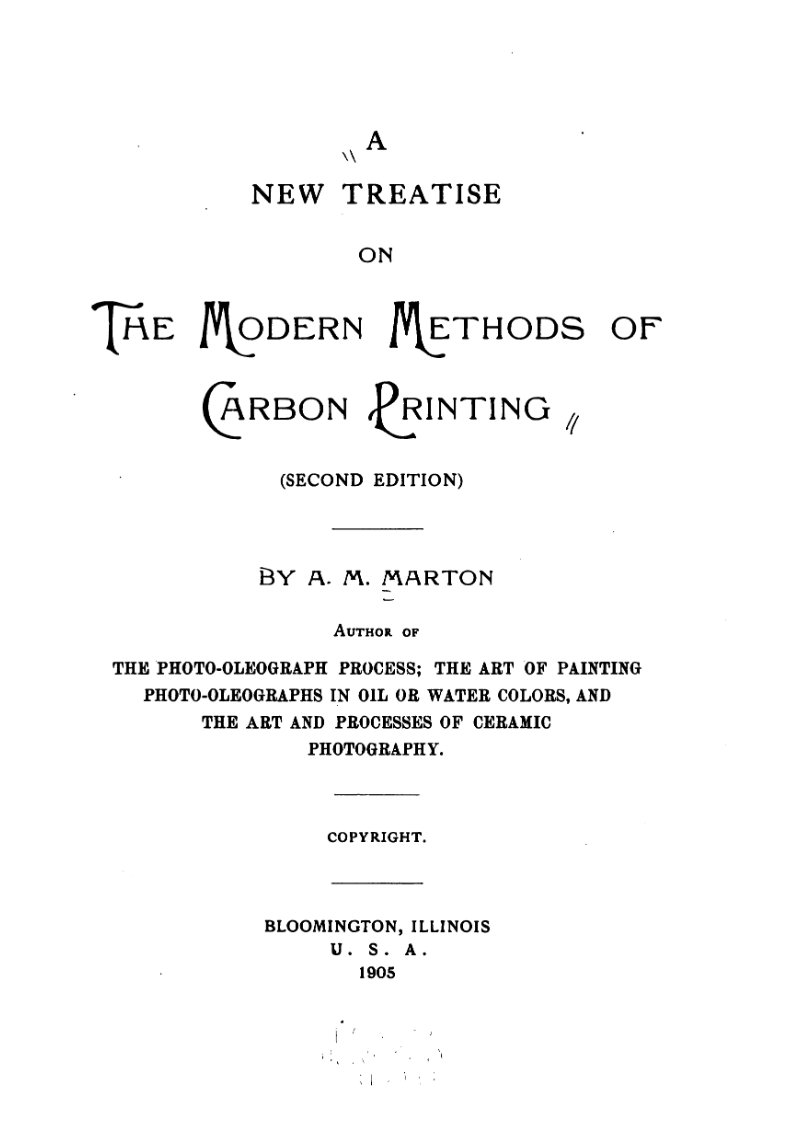
Modern Methods of Carbon Printing - Second Edition
 by COLLECTION
A New Treatise on the Modern Methods of Carbon Printing is a comprehensive 261-page technical manual self-published in Bloomington, Illinois in its second edition (1905). Recognized as the most authoritative practical guide of its time on the carbon process, this workshop manual covers the full scope of the technique—from fundamental chemistry and sensitizing solutions through to advanced double-transfer methods and in-studio tissue manufacture. A portrait photograph with handwritten dedication appears on the second page.
The work is divided into five sections. Part I establishes core principles, process overview, technical terminology, darkroom setup requirements, pigment tissue composition, bichromate solution preparation, and sensitization and drying procedures. Part II addresses negative preparation, stripping and reversing techniques for plates, photometer design (including a proprietary instrument), printing operations, and exposure theory. Part III details single and double transfer processes, development methodology, techniques for hot-weather printing, acid and alkali treatments, reduction procedures, finishing steps, transfer to glass, canvas and ivory supports, and final mounting. Part IV covers carbon positives produced on glass, window transparencies, lantern slides, toning and intensifying work, negative reproduction, and enlargements using both solar camera and artificial light sources. Part V (Appendix) documents studio manufacture of carbon tissue, pigment selection criteria, coating machinery, and a historical overview of the carbon process including Swan's foundational patent.
Table of Contents:
Part I:
- p.9 Chapter I: The Introduction
- p.12 Chapter II: A Brief Recapitulation of the Entire Carbon Process
- p.14 Chapter III: Words and Terms used in the Carbon Process
- p.20 Chapter IV: The Work Rooms, Arrangement of Light, etc.
- p.23 Chapter V: The Carbon or Pigment Tissue — Its Condition and Appearance
- p.26 Chapter VI: Bichromate of Potash — Bichromate of Ammonia — Bichromate Poisoning
- p.28 Chapter VII: The Bichromate Bath — Formulae for Special Purposes
- p.36 Chapter VIII: Practical Notes on Chemical Constituents of the Bichromate Bath
- p.39 Chapter IX: The Squeegee, its Construction and Use
- p.41 Chapter X: Sensitizing the Tissue — Various Methods
- p.48 Chapter XI: Drying the Sensitive Carbon or Pigment Tissue
- p.56 Chapter XII: Care of the Sensitive Tissue
Part II:
- p.61 Chapter I: The Negative — Quality and Style — Prisms and Reversing Mirrors
- p.66 Chapter II: Stripping and Reversing Negatives
- p.74 Chapter III: The Make-ready or Preparing the Negative for Printing
- p.78 Chapter IV: The Photometer — Marton's Photometer
- p.82 Chapter V: Printing Operations — Finding the Speed of a Negative
- p.87 Chapter VI: The Continuing Action of Light — Theory of the Latent Image
Part III:
- p.91 Chapter I: The Single Transfer Process
- p.97 Chapter II: The Transfer, or Mounting the Exposed Tissue upon Supports
- p.106 Chapter III: The Hot Water Supply
- p.108 Chapter IV: Development
- p.117 Chapter V: Marton's Perfection Developing Tray
- p.126 Chapter VI: Development on Heavy Celluloid, Porcelain or Opal Glass
- p.129 Chapter VII: Carbon Printing in Hot Weather
- p.132 Chapter VIII: The Use of Acids and Alkalies in Development
- p.138 Chapter IX: The Reduction of Carbon Pictures — The Alum Bath
- p.143 Chapter X: The Double Transfer Process — Waxing Solutions
- p.147 Chapter XI: Opal and Ground Glass Temporary Supports
- p.150 Chapter XII: Double Transfer Pictures From Polished Glass
- p.154 Chapter XIII: Transfer to Dry Collodion Plates
- p.157 Chapter XIV: The Wet Process — With Collodion Film
- p.161 Chapter XV: The Final Transfer From a Flexible Support
- p.166 Chapter XVI: Final Transfer from Glass or Opal Plates
- p.170 Chapter XVII: Mounting and Finishing — Enameling Carbon Prints
- p.175 Chapter XVIII: Carbon Pictures Upon Ivory and Canvas
Part IV:
- p.181 Chapter I: Carbon Positives on Glass
- p.183 Chapter II: Preparation of Glass Plates for Window Transparencies
- p.186 Chapter III: Window Transparencies in Monochrome and Colors
- p.190 Chapter IV: The Lantern Slide
- p.194 Chapter V: Toning and Intensifying Carbon Pictures
- p.198 Chapter VI: Reproduction of Negatives from Carbon Positive Transparencies
- p.202 Chapter VII: Carbon Enlargements by Artificial Light and Solar Camera
- p.206 Chapter VIII: Failures — Their Cause and Remedy
Part V — Appendix:
- p.214 Chapter I: Carbon Tissue — Requirements for Studio Manufacture
- p.217 Chapter II: The Choice of Pigments or Coloring Matter
- p.222 Chapter III: The Manufacture of Carbon Tissue in the Studio
- p.225 Chapter IV: The Gelatine Compound — Mixing the Pigments
- p.234 Chapter VI: Preparing the Pigment Compounds
- p.236 Chapter VII: Coating the Paper With the Pigmented Jelly
- p.242 Chapter VIII: A Brief History of the Carbon Process
- p.245 Chapter IX: Patent Specification of Swan's Carbon Process
- p.257 Chapter X: Improvements of Swan, Johnson, Sawyer and Lambert
Documentation must be downloaded on a computer (PC, Mac, or Linux).
Do not use a smartphone or tablet to download documentation; they generally lack sufficient memory capacity to handle large files, and few users know how to locate the download folder on these devices.
Once downloaded, you can use it right away and even print the pages you need, or use your smartphone in photo mode to translate into the language of your choice: Google Translate
Document Details
- Format
- Pages
- 261
- Size
- 4.3 MB
- Category
- Photography