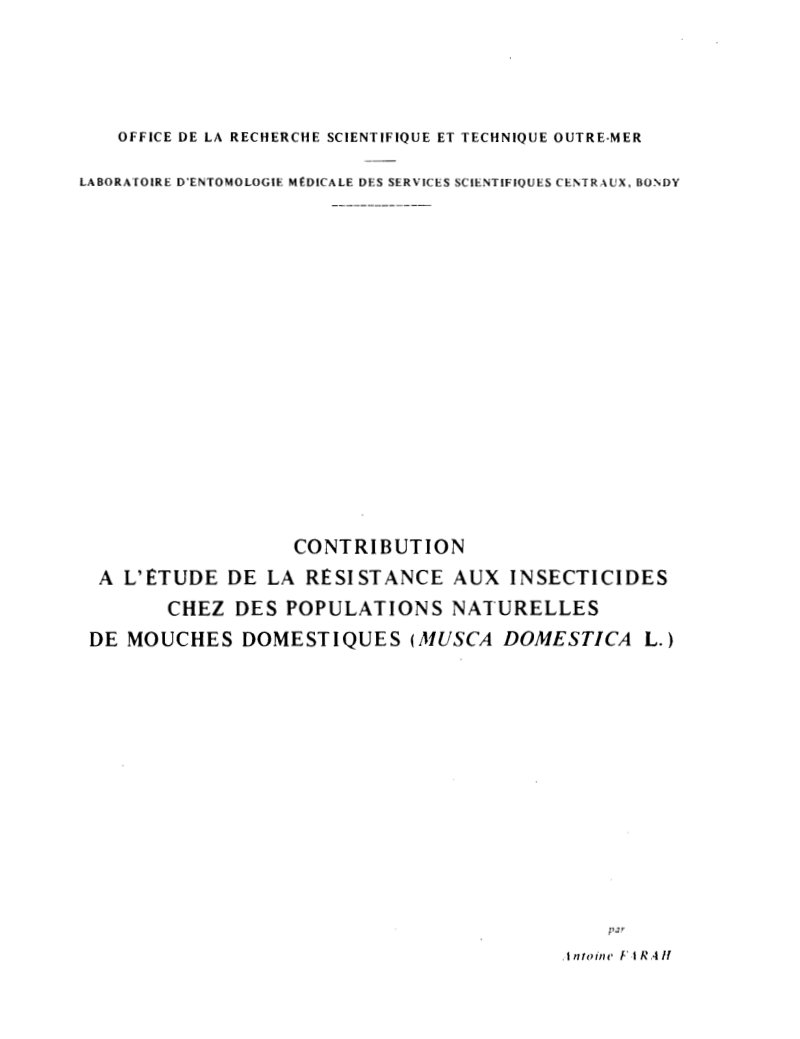
Insecticide Resistance in Natural Populations of Domestic Flies
Comprehensive doctoral thesis examining insecticide resistance in natural populations of Musca domestica (domestic fly). This reference work presents detailed genetic and biochemical aspects of resistance mechanisms, including DDT resistance through KDR genes and associated metabolic pathways, resistance to organophosphates and carbamates via altered cholinesterase and enzymatic detoxification systems. The study systematically covers biochemical and genetic investigation techniques, resistance arising from reduced insecticide absorption, and metabolic resistance pathways involving dehydrochlorinase, mixed-function oxidases, hydrolases, and glutathione S-transferase. Features extensive experimental testing of fly strains collected from diverse geographic origins, analysis of solvent effects on insecticide toxicity, and statistical evaluation of resistance distribution patterns across populations. Includes comprehensive literature review and in-depth discussion of resistance manifestation mechanisms in field populations, providing essential reference material for entomological pest management professionals, researchers studying insecticide efficacy, and those developing resistance monitoring strategies.
Table of Contents:
- Foreword .... 1
- INTRODUCTION - Factors influencing insecticide resistance in natural populations of domestic flies .... 3
- CHAPTER I - Genetic and biochemical aspects of resistance in Musca domestica L. .... 11
- 1 - Study techniques .... 13
- 1.1. Biochemical techniques .... 13
- 1.2. Genetic techniques .... 16
- 2 - Resistance due to reduced absorption of insecticides .... 17
- 3 - Resistance to DDT .... 18
- 3.1. Resistance due to the KDR gene .... 18
- 3.2. Resistance due to metabolism .... 20
- 3.2.1. Resistance due to dehydrochlorinase .... 20
- 3.2.2. Resistance due to mixed function oxidases .... 22
- 4 - Resistance to organophosphates and carbamates .... 24
- 4.1. Altered cholinesterase .... 24
- 4.2. Resistance due to metabolism .... 26
- 4.2.1. Hydrolases and glutathione-dependent transferases .... 26
- 4.2.1.1. Hydrolases .... 27
- 4.2.1.2. Glutathione S-transferase .... 33
- 4.2.2. Mixed function oxidases .... 34
- 4.2.2.1. Organophosphates .... 35
- 4.2.2.2. Carbamates .... 36
- 5 - Conclusion .... 39
- CHAPTER II - Study of insecticide resistance in domestic flies of various geographical origins .... 41
- 1 - Origin and rearing of strains .... 43
- 1.1. Geographical origin .... 43
- 1.2. Laboratory rearing of flies .... 44
- 1.3. Statistical study of weight homogeneity of female flies .... 46
- 2 - Insecticides used .... 48
- 2.1. Mode of action .... 48
- 2.2. Formulas and physico-chemical properties of insecticides .... 49
- 2.3. Dilutions .... 54
- 3 - Test execution .... 55
- 3.1. Composition of test equipment .... 55
- 3.2. Technique used .... 56
- 3.3. Role of solvent in insecticide toxicity for domestic flies .... 57
- 3.3.1. Tests .... 58
- 3.3.2. Results .... 66
- 4 - Results and interpretations of tests .... 79
- 4.1. Results .... 79
- 4.2. Interpretation of tests .... 79
- 4.3. Discussion .... 138
- 5 - Conclusion .... 141
- 5.1. Distribution of resistances .... 141
- 5.2. Modes of manifestation of these resistances .... 150
- Bibliography .... 155
- Abstract (French) .... 170
- Summary .... 173
Documentation must be downloaded on a computer (PC, Mac, or Linux).
Do not use a smartphone or tablet to download documentation; they generally lack sufficient memory capacity to handle large files, and few users know how to locate the download folder on these devices.
Once downloaded, you can use it right away and even print the pages you need, or use your smartphone in photo mode to translate into the language of your choice: Google Translate
Document Details
- Format
- Pages
- 180
- Size
- 2.3 MB
- Category
- Society & Culture