Reference Works - Service Manuals
33 manuals available for download
Reference Works is your trusted source for comprehensive technical documentation across society and culture topics. Our curated collection of 33 professional guides includes service manuals, repair guides, owner's manuals, and workshop documentation available as instant PDF downloads. Whether you need a detailed troubleshooting guide, maintenance manual, parts list, or user manual to understand complex systems and practices, our reference materials provide authoritative information for professionals, researchers, and informed readers. Each document is carefully selected to deliver practical knowledge and technical clarity on subjects ranging from institutional practices to specialized methodologies.
Baltic States Foreign Aid Donors Sponsorship Role 1985-2013
Doctoral thesis examining the position and role of Baltic States (Estonia, Latvia, Lithuania) between Nordic countries and post-Soviet states through the lens of sponsorship and solidarity action from 1985 to 2013. Political science research on foreign aid, development cooperation, and institutional transfers.
Crisis Management: Tools for Decision Makers
Comprehensive operational guide for managers and decision-makers facing crisis situations. This reference work addresses the complex dynamics of major crises, from technological failures to natural disasters, equipping leaders with essential frameworks for understanding crisis phenomena and recognizing the real difficulties encountered by responsible parties at every organizational level. Part One examines crisis dynamics—the transition from normalcy to disruption, the concept of major events, and the loss of reference frameworks that guide routine operations. Part Two delivers strategic action guidance for avoiding immediate disqualification, developing effective decision-making capacity, and conducting crisis operations through to resolution. Part Three focuses on organizational learning and cultural change necessary for long-term resilience. The guide emphasizes that effective crisis management depends not on simple procedures or checklists but on sound judgment, comprehensive information gathering, critical thinking, and integration of multiple stakeholder perspectives—victims, media, experts, and political authorities—to navigate uncertainty and restore operational stability. Table of Contents: - Acknowledgements - Introduction: thinking, preventing and managing crises - Preliminary questioning: the demand and the project - PART ONE: CRISIS DYNAMICS - The picture of difficulties awaiting the decision-maker - 1. Normality, disruption, crisis - 2. The major event, universe of excess - 3. A resonance phenomenon between the event and its context - 4. Crisis, or the loss of the frame of reference - 1. The notion of crisis: resistance and richness of the concept - 2. The crisis experience: some keys for the decision-maker - 5. Crisis dynamics: recognizing the difficulties - 1. Entry into crisis: destabilization and inaugural defeat - 2. An immediate reinforcement for the crisis: the past presents its bill - 3. Individuals: thrown to the edge of the abyss - 4. Small groups: between cacophony and pathological closure - 5. Organizations: operations at breaking point - 6. Large systems: between unmanageable complexity and disintegration - 7. Expertise and experts: ruts and false securities - 8. Facing the media: between terror and revolt - 9. Facing victims of the event: the risk of paralysis and contempt - 10. Numerous social actors - 1. Unions and internal structures of the organization - 2. Populations: tenacious and dangerous myths - 3. Associations, emerging groups - 4. Elected officials and political authorities - 5. A proliferation of actors from nowhere - 6. An often forgotten actor: the justice system - 6. The decision-maker's confusion: which levers? which decisions? - 1. Decision-making mechanisms greatly affected and insufficient in any case - 2. A system that no longer responds - 3. The black hole - Part two: strategic action - 7. Avoiding immediate disqualification - 0. Quality preliminary planning - 1. Detect. Alert. Take charge. - 2. Trigger safeguard interventions and relevant emergency actions - 3. Search for information - 4. Establish a logbook - 5. Assemble a team, isolate crisis management - 6. Avoid any aggravating gesticulation - 7. Gain foothold in communication - 8. The beginning of an integrative approach: start thinking about an action plan - 9. In summary: do not leave unmanageable terrain - 8. Attitudes and capacities to gain control over the event - 1. Develop strong information gathering capacity - 2. Open reflection: questioning and distancing - 3. Open networks, weave a background canvas - 4. Prepare the conditions for decision-animation capacity - 5. In general support: a critical intelligence group - 6. Strive to identify logics of action - 9. Leading the crisis: choices and accompaniment - 1. The founding act: positioning - 2. The global conduct of the overall response - 3. Direct piloting: general arrangements, crisis cells - 4. Mastering the question of expertise - 5. Leading communication - 6. Leading the crisis over time... until its end - 7. Also leading the post-crisis - Part three: learning - 10. A foundation of refusals... and the time for questions - 11. Engaging and conducting learning - 1. The perspective: a cultural change in organizations - 2. Strategies for change - Conclusion: facing unprecedented crises, turning points to operate - Bibliography - Index - 1. Index of cited names - 2. Index of cited cases - List of plates: - Plate 1: The classic accident - Plate 2: The major event - Plate 3: Crisis terrains - Plate 4: Crisis: a triple challenge - Plate 5: Decision processes in crisis; the media ordeal - Plate 6: Avoiding immediate disqualification - Plate 7: To gain control over the event - Plate 8: Leading the crisis
Dacia: Journal of Archaeology and Ancient History, Vol. VIII 1964
Volume VIII of the Dacia archaeological journal, published in 1964 by the Academy of the Romanian People's Republic, brings together twenty major research articles spanning two decades of Romanian archaeological investigation (1944–1964). This scholarly reference work surveys Romanian prehistory and ancient history comprehensively: Paleolithic proto-hominids, Neolithic and Bronze Age cultures, Hallstatt and Iron Age developments, and Greek and Thracian settlements. The volume devotes substantial attention to Roman Dacia, examining the Cucuteni and Gumelniţa civilizations, ancient chariot models, Dacian military organization, and the enduring question of Daco-Roman cultural continuity. Additional sections address medieval archaeology and numismatic discoveries, supported by detailed notes on current excavations throughout Romania. Contributions from leading scholars including Daicoviciu, Berciu, and Dumitresci engage critical questions in Southeast European antiquity and trace the formation of Romanian culture across millennia. Table of Contents: - Em. Condurachi, Twenty years of archaeological research in Romania (1944-1964) .... 5 - Dorin Popescu, The centenary of the National Museum of Antiquities .... 39 - C. S. Nicolăescu-Plopşor, New data on the possibility of the existence of protohominins in the Villafranchian of Romania .... 47 - Vladimir Dumitrescu, Considerations and new data on the problem of synchronism of the Cucuteni and Gumelniţa civilizations .... 53 - Gh. Bichir, On the problem of the oldest chariot models discovered in Romania .... 67 - Alexandru Popa and Ion Berciu, Contribution to the study of Hallstattian object deposits .... 87 - Sebastian Morintz, Some problems concerning the early Hallstatt period on the Lower Danube in light of the Babadag excavations .... 101 - K. Horedt, The use of iron in Romania until the 6th century A.D. .... 119 - Suzana Dimitriu, Events of the Pontus-Euxinus at the end of the 6th century B.C. reflected in the history of Histria .... 133 - M. Macrea, Exercitus Daciae Porolissensis and some considerations on the organization of Roman Dacia .... 145 - Gabriella Bordenache, Themes and motifs in Roman-era funerary sculpture in Moesia Inferior .... 161 - D. Protase, Considerations on the continuity of Daco-Romans in post-Aurelian Dacia, in light of archaeological and numismatic research .... 177 - G. Diaconu, Indigenous peoples and migrating peoples in the 4th century A.D. on Romanian territory (Tîrgşor-Gherăseni variant) .... 195 - B. Mitrea and C. Preda, Some problems relating to the Sîntana-Tcherniakhov type necropolises discovered in Wallachia .... 211 - I. Barnea, Seals of two unknown governors of the Paristrion theme .... 239 - P. Diaconu, On the question of clay cauldrons on the territory of the RPR .... 249 - N. Constantinescu, The stage and perspectives of archaeological research on the medieval village of Romania .... 266 - Mircea D. Matei, The medieval town and Romanian archaeology: current state of research .... 279 - Notes and information - Al. Păunescu, On the ancient Neolithic of Drăghiceanu and some late Tardenoisian survivals .... 297 - Silvia Marinescu-Bîlcu, Reflections of the relationships between the Hamangia and Pre-Cucuteni civilizations in the Pre-Cucutenian sculpture of Tîrpeşti .... 307 - D. Berciu, On the beginnings of the Bronze Age on the Lower Danube .... 313 - Alexandru Vulpe, The phases of the Tei civilization in light of the Novaci excavations .... 319 - Th. Sauciuc-Săveanu, Remarks on the Thiasite inscription from Kallatis from the time of Basileus Simos .... 331 - Radu Vulpe, Ex-voto to the Thracian horseman from Callatis .... 335 - D. Tudor, Pedites singulares at Buridava .... 345 - Constantin Preda, Coins imitating the "Larissa" type and with Janiform head discovered at Bugiuleşti (Oltenia) .... 363 - Maria Comşa, On the question of interpreting some graffiti from Bessarabia .... 363 - Bucur Mitrea, Ancient and more recent discoveries of antique and Byzantine coins in the Romanian People's Republic .... 371 - Dorin Popescu, Archaeological excavations in the Romanian People's Republic in 1963 .... 385 - C. Morintz, Romanian-Soviet seminar on the archaeology of primitive communal society .... 405 - M. Comşa, Report on the work of the Romanian-Bulgarian seminar held between November 12 and 15, 1962 .... 415 - Abbreviations of most frequently cited publications .... 419

Earth: Understanding Our Planet
A comprehensive illustrated reference guide to understanding Earth's origins, structure, and dynamic systems. This 130-page work explores the planet's 4.6 billion-year geological history, from its formation within a primordial dust cloud through to the emergence of complex life. The guide examines Earth's internal composition in detail—the structure of the crust, mantle, and core—alongside fundamental concepts in mineralogy and geology essential to understanding how the planet works. Plate tectonics and volcanism receive extensive treatment, covering earthquake mechanisms, volcanic eruptions, and the forces that shape continents. Earth's water systems are thoroughly documented, from ocean circulation patterns, currents, and tides to tsunamis and freshwater environments including rivers, lakes, and groundwater. The landscape evolution section addresses erosion processes, mountain building, glaciation, and coastal dynamics—the visible evidence of geological change. Additional topics encompass Earth's magnetic field, the rock cycle, and systematic mineral classification. The work concludes with practical geographic and cartographic information: coordinate systems, map projections, and satellite technology for modern Earth observation. Throughout, detailed illustrations and cross-section diagrams clarify complex scientific concepts. Table of Contents: - The History of Earth .... 6 - The birth of Earth .... 8 - The geologic time scale .... 10 - Life conquers the continents .... 12 - Understanding geologic time .... 14 - The Structure of Earth .... 16 - Inside the Earth .... 18 - Geomagnetism .... 20 - Minerals .... 22 - The shape of minerals .... 24 - The rock cycle .... 26 - Types of rocks .... 28 - Tectonics and Volcanism .... 30 - Plate tectonics .... 32 - The fate of Pangaea .... 34 - Continental drift .... 36 - Volcanoes .... 38 - Volcanism .... 40 - Volcanic eruptions .... 42 - Hot spots .... 43 - Geysers .... 44 - Earthquakes .... 46 - Seismic waves .... 48 - Water and the Oceans .... 50 - Waterways .... 52 - Rivers and lakes of the world .... 54 - The world ocean .... 56 - The ocean floor .... 58 - Trenches and oceanic ridges .... 60 - Ocean currents .... 62 - Waves .... 64 - Tsunamis .... 66 - Tides .... 68 - The Evolution of Landscapes .... 70 - Erosion .... 72 - The erosion cycle .... 74 - Mass movements .... 75 - Caves .... 76 - Mountain formation .... 78 - Mountains of the world .... 80 - Coastline configuration .... 82 - Glaciers .... 84 - Glacial erosion .... 86 - Icebergs .... 87 - Representing the Earth .... 88 - Geographic coordinates .... 90 - Map projection .... 92 - Cartography .... 94 - Cartographic conventions .... 96 - Physical and topographic maps .... 98 - Thematic maps .... 100 - Remote sensing .... 102 - Satellites and shuttles .... 104 - Time zones .... 106 - The Continents .... 108 - Configuration of the continents .... 110 - Antarctica .... 111 - North America .... 112 - South America .... 114 - Europe .... 116 - Asia .... 118 - Oceania .... 120 - Africa .... 122 - Glossary .... 124 - Index .... 126
Energy Sobriety: Quantified Proposals for Rapid Consumption Reduction
This comprehensive reference work presents the NegaWatt Association's quantified proposals for reducing energy consumption by at least 10% within two years in response to the current energy crisis. Developed by energy professionals with over 20 years of field expertise in sobriety measures, the proposals focus on actionable solutions implementable immediately through winter 2024 and beyond. The analysis prioritizes the building sector as the primary focus area, given its vulnerability to gas and electricity supply tensions and its multiple short-term action opportunities. Transportation sector measures are also included to address rising fuel prices. The document employs rigorous methodology grounded in direct experience from association members, with detailed calculation chains supporting each measure. It addresses implementation challenges across three dimensions: what actions to take, who must be mobilized, and how to overcome barriers. Exclusions account for vulnerable populations and technical constraints. The cumulative potential reaches approximately 30% of residential and tertiary sector consumption, with realistic implementation rates achieving the 10% reduction target set by government objectives. Table of Contents: - Summary of proposals .... page 14 - Building - Residential .... page 14 - Heating .... page 14 - Domestic hot water .... page 14 - Household appliances / Cooking .... page 14 - Building - Tertiary .... page 14 - Heating .... page 14 - Domestic hot water .... page 14 - Ventilation .... page 14 - Air conditioning .... page 14 - Lighting .... page 14 - IT and networks .... page 14 - Other electricity uses .... page 14 - Transport .... page 14
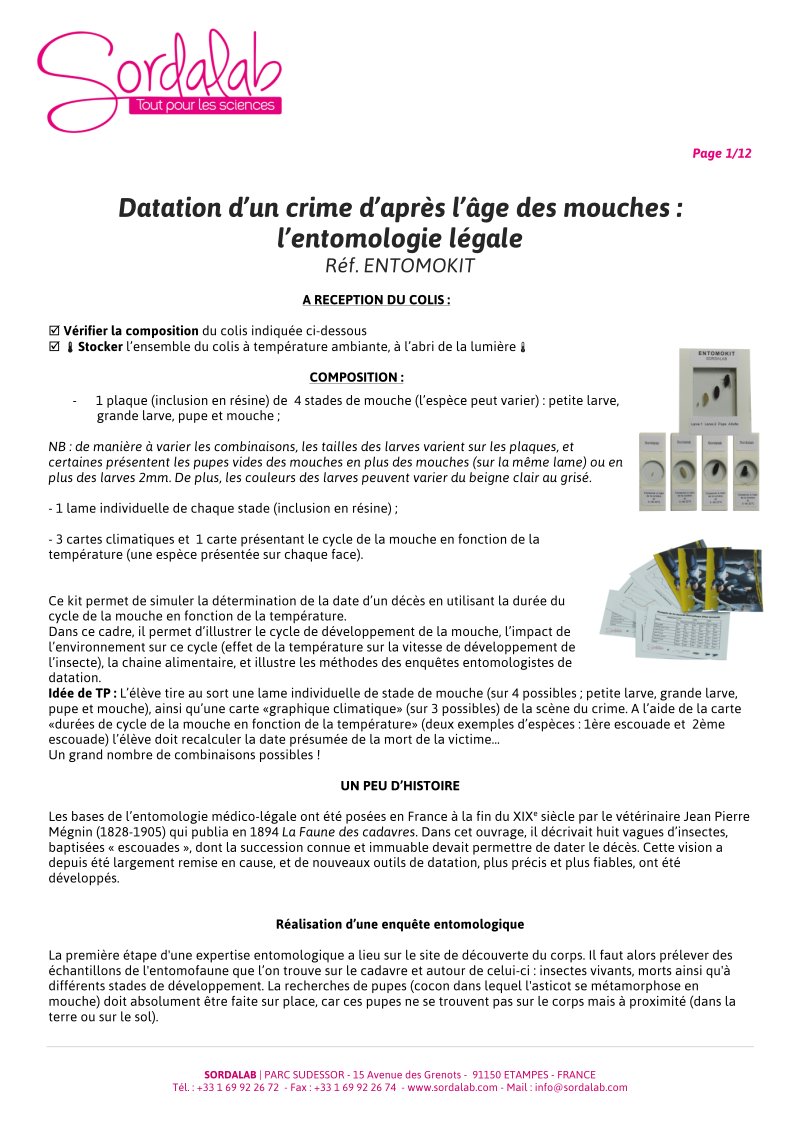
Forensic Entomology: Dating Crime by Fly Age - Educational Kit
Comprehensive educational manual accompanying the ENTOMOKIT, a hands-on learning system for forensic entomology. This practical resource helps students and instructors determine time of death by analyzing fly development cycles across different temperature conditions. The kit includes preserved specimens at four distinct life stages—small larva, large larva, pupa, and adult fly—mounted on resin plates, plus individual stage slides, climate reference cards, and temperature-dependent development charts specific to Calliphora (blowfly, first colonizer wave) and Sarcophaga (flesh fly, second wave). The manual establishes the historical context of forensic entomology with reference to Mégnin's foundational work from 1894, then walks through practical crime scene insect collection methods, the distinction between necrophagous and necrophilic species, and the documented succession of seven insect waves that colonize decomposing remains. Central to the guide are step-by-step calculation techniques with worked examples that show how thermal cumulative requirements—the temperature-dependent developmental thresholds unique to each fly species—allow forensic practitioners to back-calculate death date from larval age. Positioning exercises help learners plot fly developmental stages on climate charts to understand growth timelines in real-world conditions.
French Legal System's Resistance to Potential Authoritarian Shock
This comprehensive academic report examines the structural resilience of the French legal system against potential authoritarian takeover, using stress-testing methodology inspired by European banking supervision practices. The study analyzes weaknesses and strengths across institutional safeguards including separation of powers, judicial independence, civil service protections, independent regulatory authorities, and non-institutional counterbalances. The report draws comparative analysis with Hungary and Poland, documenting how democratic regression occurs through systematic dismantling of rule of law mechanisms. Specific focus areas include executive encroachment via ordinances and constitutional article 16, public prosecutors' vulnerability, constitutional council safeguards, civil service politicization risks, and the capacity of media, civil society, and academia to resist authoritarian measures. The research identifies critical structural gaps requiring urgent constitutional and legislative reforms to strengthen democratic protections. Table of Contents: - Summary .... 5 - Preface .... 7 - 1. introduction .... 11 - Part i: the general analytical framework .... 15 - 2. autocratic drift: user manual .... 17 - 2.1 Dismantling democracy and the rule of law: Key stages .... 17 - 2.2 How to confiscate power in a single electoral term: the example of Orbán's Hungary .... 20 - 2.3 Key stages of Poland's transformation process into the EU's second authoritarian regime .... 24 - The progressive takeover of the judiciary .... 25 - The progressive seizure of the media .... 27 - 3. evaluation of the french situation in the commission's annual rule of law report .... 31 - 3.1 The 2020 and 2021 reports on the rule of law in France .... 32 - 3.2 Putting into perspective compared to the situation in Hungary and Poland .... 33 - Part ii: study of the french case – strengths and weaknesses .... 37 - 4. the separation between executive and legislative powers .... 39 - 4.1. Recourse to ordinances under Article 38 .... 40 - 4.2. Referendums .... 40 - 4.3. Article 16 of the French Constitution .... 41 - 5. the independence of justice .... 45 - 5.1. The judicial order .... 45 - 5.2. The administrative order .... 49 - 5.3. The Constitutional Council .... 51 - 6. the civil service .... 55 - 6.1. Balancing elements .... 56 - 6.2. Risk identification .... 57 - 7. independent administrative authorities and other regulatory authorities .... 63 - 7.1. Status of independent authorities .... 65 - 7.2. Appointment of members of independent authorities .... 67 - 7.3. Term of office of members of independent authorities .... 68 - 7.4. Budget .... 69 - 7.5. External controls .... 70 - 7.6. Responsibility .... 71 - 8. non-institutional counter-powers .... 73 - 8.1. The resistance capacity of the media .... 74 - 8.2. The resistance capacity of civil society .... 77 - 8.3. The resistance capacity of the university .... 81 - Table of contents .... 85
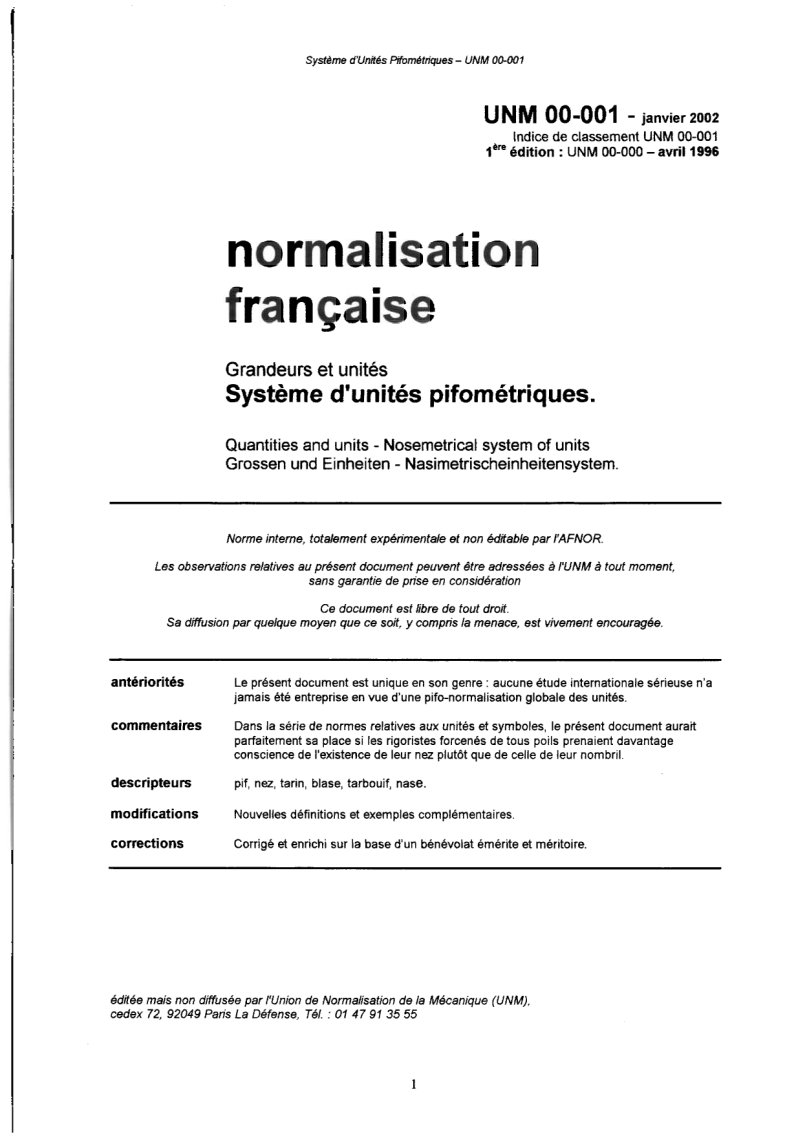
French Normalization - Nosometric System of Units
This official AFNOR standard document UNM 00-001 from January 2002 establishes the foundational rules and terminology for the nosometric system of units, a whimsical measurement framework grounded in subjective human perception and estimation. The manual outlines the core principles governing pifometry, the science of quantifying intangible and personal quantities that vary according to individual perspective and context. It defines three fundamental principles: pifometers remain strictly personal and non-transferable, contrary pifometric expressions do not cancel one another, and averaging pifometric values yields no meaningful information. This reference document comprehensively catalogs quantity units including palanquée, tapée, flopée, and triplotée, value units such as tripette and roupie de sansonnet, and specialized measurement units for destination, adjustment, length, distance, time, speed, temperature, maritime applications, and numerous other domains. Each unit entry provides clear definitions, practical examples of usage, and interpretive guidance. The document underscores pifometry as an ancient and culturally universal practice, distinct from conventional measurement systems. Table of Contents: - Foreword .... 3 - 1 - Scope .... 4 - 2 - Principles of nosemetry .... 4 - 3 - Rules of nosemetry .... 4 - 4 - Units of the nosemetric system .... 5 - 4.1 - Units of quantity .... 5 - 4.2 - Units of value .... 7 - 4.3 - Units of estimation and adjustment .... 7 - 4.4 - Units of length and distance .... 9 - 4.5 - Units of time .... 9 - 4.6 - Units of speed .... 10 - 4.7 - Monetary units .... 11 - 4.8 - Units of temperature .... 11 - 4.9 - Miscellaneous units .... 11 - 4.10 - Maritime units .... 12 - Bibliographic appendix .... 13

French Police Practices Observatory: Third Report on Public Order Maintenance
Third comprehensive report from the Toulouse Observatory of Police Practices analyzing law enforcement interventions during street demonstrations from April 2021 to November 2023. This scientific study documents police operations, violent practices, and restrictions on civil liberties during public protests in France. The report examines over 220 observed demonstrations, detailing observation methodology, observer protocols, and documented incidents including targeted grenade throws, tear gas deployment, and physical violence against both protesters and independent observers. Conducted by researchers from the CNRS, the Copernic Foundation, and the Human Rights League, this analysis provides critical examination of proportionality in riot control tactics and their compliance with international standards for independent protest monitoring and human rights documentation.
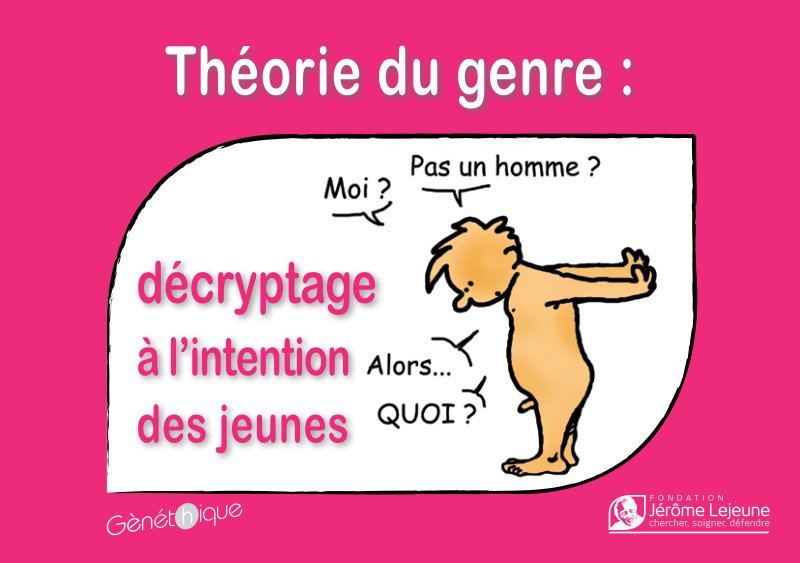
Gender Theory: Decryption Guide for Young People
Educational reference guide published by the Jérôme Lejeune Foundation designed to help young readers understand gender theory and its underlying claims. This comprehensive resource examines gender theory as a hypothesis proposing that human sexual identity depends primarily on socio-cultural environment rather than biological sex. The guide traces embryonic development from conception onward, establishing the biological facts of chromosomal sex determination and clarifying fundamental reproductive science. It systematically analyzes ambiguities and inconsistencies found in curriculum materials, particularly in life sciences education (SVT), where scientific fundamentals are sometimes presented in ways that obscure established biological facts. The document explores the philosophical and feminist intellectual origins of gender theory and examines how these ideas are introduced into educational settings and their implications for understanding family structures and human reproduction. A key focus is identifying how certain biological realities are presented ambiguously or selectively in textbooks, potentially allowing ideological perspectives to enter what should be straightforward scientific instruction. Throughout, the guide emphasizes critical thinking skills, enabling young people to evaluate claims they encounter in educational and media contexts while maintaining intellectual independence and a clear grasp of biological science. Table of Contents: - Reminder: Embryonic development .... pages 6-7 - 1/ Gender theory .... pages 8-11 - 2/ Ambiguities that raise questions .... pages 12-15 - 3/ Scientific fundamentals set aside .... pages 16-17 - 4/ A distorted description of embryonic development .... pages 18-19 - 5/ An incomplete presentation of puberty .... pages 20-23 - 6/ Overrepresented sexual identity disorders .... pages 24-27 - 7/ A non-biological subject: sexual identity and orientation .... pages 28-37 - 8/ About sexual desire .... pages 38-39 - Index, To go further... .... pages 40-42 - Order forms and support .... pages 43-44
Hospital Information System Implementation in Francophone Africa
This doctoral thesis provides an in-depth examination of hospital information system implementation across French-speaking African countries, with particular emphasis on practical deployment in Mali. The work addresses the core obstacles that arise when establishing healthcare IT infrastructure in resource-constrained environments—cultural adaptation, political feasibility, organizational readiness, and the technical realities of limited connectivity and infrastructure. The thesis documents Cinz@n, an open-source hospital information system that was developed, tested, and validated directly within Malian healthcare settings. Core technical content covers system architecture design, patient identification protocols aligned with international standards, semantic coding frameworks for medical diagnoses and clinical procedures, workflow-oriented implementation approaches, and proven methodologies for rolling out such systems in challenging contexts. The thesis undertakes a rigorous comparison between established commercial platforms—Cerner and McKesson—and open-source alternatives, making a detailed case for why adaptable, locally-maintainable solutions often outperform proprietary offerings in developing healthcare economies. Extended sections tackle IT governance structures, project management discipline under resource constraints, organizational change management (a critical success factor often overlooked), and pragmatic risk mitigation strategies grounded in real implementation experience. The evaluation of Cinz@n itself spans functional capability assessment, practical user interface design, staff knowledge acquisition and retention, and measurable data quality outcomes. Throughout, the thesis distills actionable recommendations for healthcare organizations across under-resourced settings seeking to adopt information systems that can be maintained and evolved with local capacity, rather than systems locked into expensive external dependencies.
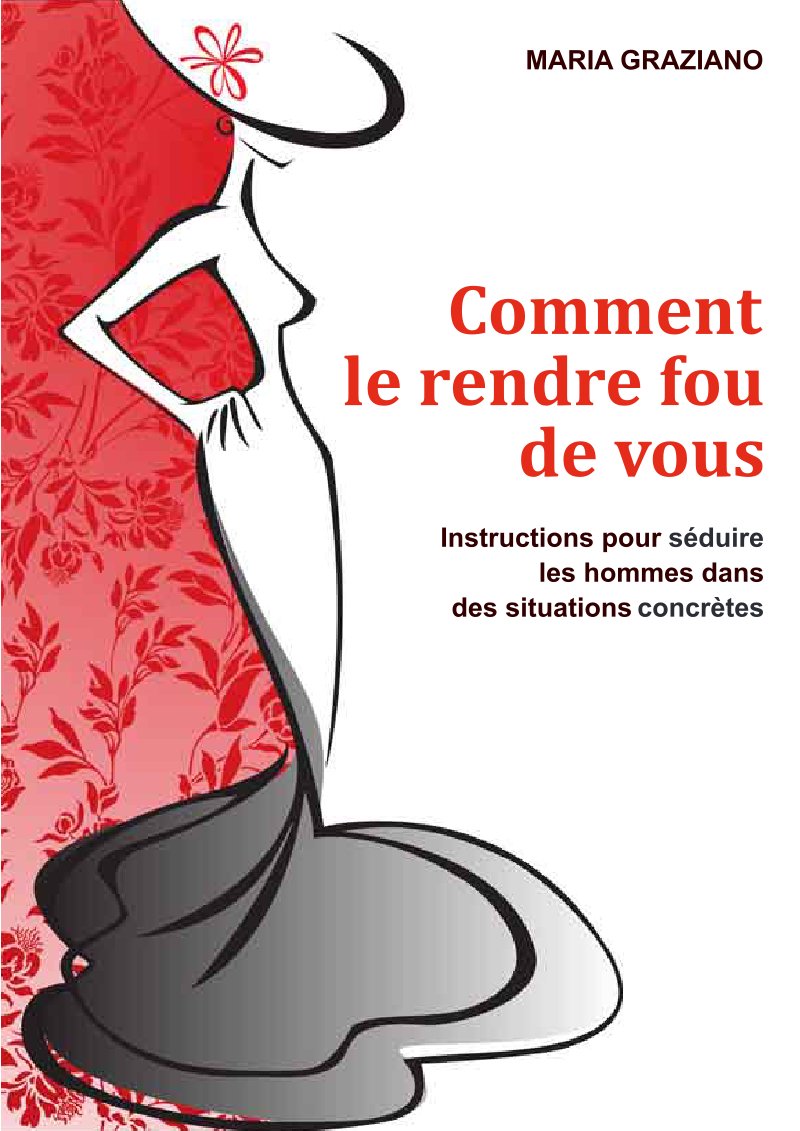
How to Make Him Crazy About You: Practical Seduction Techniques
A comprehensive guide to seduction that explores the art of attracting and charming men in concrete situations. The book presents seduction as a legitimate skill and form of art rather than manipulation, emphasizing non-violent psychological tactics and genuine connection. The manual covers four main scenarios: pursuing someone new, seducing someone already in a relationship, rekindling romance with a current partner, and creating memorable moments for special occasions. The guide provides practical advice on detecting men's hidden fantasies and desires, using them ethically to build attraction and devotion. Key concepts include the importance of confidence, mystery, and strategic flirtation as entry points to deeper seduction. The guide distinguishes between flirting—which remains uncommitted—and seduction, which requires deliberate intention and control. Emphasis is placed on becoming the leader in romantic interactions while maintaining mutual respect and trust. Table of Contents: - Foreword .... 4 Only manipulation?! - Introduction .... 6 The art of seduction - Chapter 1: The Crush .... 19 - How to attract his attention to me? .... 19 - I want him to fall head over heels – knowing how to flirt skillfully .... 38 - The real obstacles to seduction .... 44 - Making him see reason – the perfect date .... 47 - Chapter 2: The One Who Is Already in a Relationship .... 50 - How to become attractive .... 51 - How to break up his romantic relationship .... 55 - Is he faithful to me? .... 61 - Chapter 3: The Regular Partner .... 66 - How to attract his attention (again) .... 67 - Making him faithful forever .... 78 - A diamond with some flaws is preferable to a simple stone without any .... 82 - Do you want a marriage proposal? .... 87 - Chapter 4: Special Occasions, Fabulous Ideas .... 98
Inclusive Writing Manual: Advancing Gender Equality Through Language
Comprehensive guide to inclusive writing practices that promotes gender equality through deliberate, thoughtful language use. Developed by Mots-Clés communication agency in alignment with guidance from France's High Council for Gender Equality, this manual delivers practical strategies for genuinely non-discriminatory institutional communication. The work establishes three foundational conventions: grammatical gender agreement applied consistently to job titles, professions, and ranks; balanced representation of feminine and masculine forms through alphabetical enumeration, the medial point, or gender-neutral terminology; and systematic elimination of common noun antonomasies conventionally used for "Woman" and "Man". The reference manual includes extensive vocabulary tables presenting frequently encountered terms with both feminine and masculine variants, detailed argumentation that directly addresses the objections most commonly raised against inclusive writing, survey findings on actual acceptance and adoption of inclusive writing across institutions, and a substantial bibliography of theoretical foundations. Tailored for institutions, businesses, and professional associations undertaking genuine reform of their institutional communication. This third edition, updated in January 2019, incorporates real-world implementation feedback and lessons learned from practitioners applying these conventions across diverse organizational contexts. Table of Contents: - Preamble .... 4 - Three conventions of inclusive writing adopted by Mots-Clés .... 7 - Concretely .... 8 - Table of inclusive writing for frequently used terms .... 13 - Indicative bibliography .... 17 - FAQ on arguments .... 19 - A survey on inclusive writing .... 24 - Postface .... 26 - And now? .... 27 - Contact .... 28
Insecticide Resistance in Natural Populations of Domestic Flies
Comprehensive doctoral thesis examining insecticide resistance in natural populations of Musca domestica (domestic fly). This reference work presents detailed genetic and biochemical aspects of resistance mechanisms, including DDT resistance through KDR genes and associated metabolic pathways, resistance to organophosphates and carbamates via altered cholinesterase and enzymatic detoxification systems. The study systematically covers biochemical and genetic investigation techniques, resistance arising from reduced insecticide absorption, and metabolic resistance pathways involving dehydrochlorinase, mixed-function oxidases, hydrolases, and glutathione S-transferase. Features extensive experimental testing of fly strains collected from diverse geographic origins, analysis of solvent effects on insecticide toxicity, and statistical evaluation of resistance distribution patterns across populations. Includes comprehensive literature review and in-depth discussion of resistance manifestation mechanisms in field populations, providing essential reference material for entomological pest management professionals, researchers studying insecticide efficacy, and those developing resistance monitoring strategies. Table of Contents: - Foreword .... 1 - INTRODUCTION - Factors influencing insecticide resistance in natural populations of domestic flies .... 3 - CHAPTER I - Genetic and biochemical aspects of resistance in Musca domestica L. .... 11 - 1 - Study techniques .... 13 - 1.1. Biochemical techniques .... 13 - 1.2. Genetic techniques .... 16 - 2 - Resistance due to reduced absorption of insecticides .... 17 - 3 - Resistance to DDT .... 18 - 3.1. Resistance due to the KDR gene .... 18 - 3.2. Resistance due to metabolism .... 20 - 3.2.1. Resistance due to dehydrochlorinase .... 20 - 3.2.2. Resistance due to mixed function oxidases .... 22 - 4 - Resistance to organophosphates and carbamates .... 24 - 4.1. Altered cholinesterase .... 24 - 4.2. Resistance due to metabolism .... 26 - 4.2.1. Hydrolases and glutathione-dependent transferases .... 26 - 4.2.1.1. Hydrolases .... 27 - 4.2.1.2. Glutathione S-transferase .... 33 - 4.2.2. Mixed function oxidases .... 34 - 4.2.2.1. Organophosphates .... 35 - 4.2.2.2. Carbamates .... 36 - 5 - Conclusion .... 39 - CHAPTER II - Study of insecticide resistance in domestic flies of various geographical origins .... 41 - 1 - Origin and rearing of strains .... 43 - 1.1. Geographical origin .... 43 - 1.2. Laboratory rearing of flies .... 44 - 1.3. Statistical study of weight homogeneity of female flies .... 46 - 2 - Insecticides used .... 48 - 2.1. Mode of action .... 48 - 2.2. Formulas and physico-chemical properties of insecticides .... 49 - 2.3. Dilutions .... 54 - 3 - Test execution .... 55 - 3.1. Composition of test equipment .... 55 - 3.2. Technique used .... 56 - 3.3. Role of solvent in insecticide toxicity for domestic flies .... 57 - 3.3.1. Tests .... 58 - 3.3.2. Results .... 66 - 4 - Results and interpretations of tests .... 79 - 4.1. Results .... 79 - 4.2. Interpretation of tests .... 79 - 4.3. Discussion .... 138 - 5 - Conclusion .... 141 - 5.1. Distribution of resistances .... 141 - 5.2. Modes of manifestation of these resistances .... 150 - Bibliography .... 155 - Abstract (French) .... 170 - Summary .... 173
Inventing Museums for Tomorrow: 21st Century Museums Report
This official report from the 21st Century Museums Mission, presented to the French Ministry of Culture, delivers a comprehensive strategic vision for the future of French museums. Developed over six months through extensive stakeholder consultation involving over 700 museum professionals, institutional partners, and nearly 3,000 citizens, the document identifies four emerging museum models suited to contemporary society: the ethical and civic museum, the multifaceted museum operating across in-situ, off-site, and virtual spaces, the inclusive and collaborative museum, and the museum functioning as a creative professional ecosystem. The report provides detailed structural recommendations and functional evolution pathways organized across territorial, organizational, and curatorial dimensions. It incorporates in-depth working group analyses, international institutional case studies, and thorough examination of citizen consultation data revealing expectations for museums that are more open, welcoming, and genuinely participatory. This reference work serves as both strategic guidance and actionable framework for museum leaders and cultural policymakers navigating institutional transformation. Table of Contents: - Preface .... 7 - Introduction .... 9 - Context .... 13 - SYNTHESIS: Positioning French Museums in the 21st Century: Emerging Models, Functional Evolutions and Projects to Launch .... 21 - The ethical and civic museum .... 25 - Emerging models .... 25 - Projects to launch .... 26 - Reference experiences .... 28 - The protean museum .... 35 - Emerging models .... 35 - Projects to launch .... 36 - Reference experiences .... 38 - The inclusive and collaborative museum .... 47 - Emerging models .... 47 - Projects to launch .... 48 - Reference experiences .... 50 - The museum as a creative professional ecosystem .... 59 - Functional evolutions .... 63 - Projects to launch .... 64 - Reference experiences .... 66 - Reports from the four working groups .... 73 - An ethical and civic museum .... 75 - A territorial foundation in perpetual reconstruction .... 76 - Inclusive values .... 80 - Debates and creation .... 86 - New projects to launch or continue .... 88 - The protean museum, in situ, beyond the walls, dematerialized .... 91 - In situ museum: the museum as a living place .... 91 - The museum beyond the walls: the museum in its territory and towards its audiences .... 97 - The digital/virtual museum: a field of experimentation .... 103 - Recommendations .... 109 - Reference experiences .... 111 - The inclusive and collaborative museum .... 113 - Building a new relationship with audiences, in an era of post-mediation .... 114 - Rethinking institutions as platforms of potentialities .... 120 - Reconsidering functional structures and governance modes .... 130 - Reference experiences .... 142 - The museum as a creative professional ecosystem .... 143 - Introduction .... 143 - Axes of reflection .... 146 - Prospective reflections, projects to launch and recommendations .... 152 - Emerging models and projects .... 163 - Reference experiences .... 167 - Citizen consultation .... 169 - What we know about museum audiences today .... 171 - Museums and audiences .... 171 - Visitors and visits .... 172 - The national consultation "let's imagine together the museum of tomorrow" .... 177 - Methodology .... 177 - Lexical analysis of contributions and votes from the citizen consultation "Let's imagine together the museums of tomorrow" .... 178 - Lexical analysis of contributions .... 178 - Content analysis and synthesis of votes .... 187 - Survey of the national population: a more open, more convivial museum oriented towards younger generations .... 193 - Opening the museum more to give everyone the desire to visit exhibitions more often .... 193 - Human interaction and conviviality at the heart of a new experience, more participative, more interactive .... 196 - Getting more involved in museum life .... 199 - Synthesis and conclusion .... 203 - Annexes .... 207 - Annex 1: Mission letter .... 209 - Annex 2: List of people interviewed .... 211 - Annex 3: The 21st Century Museums Mission at work .... 227 - Annex 4: Bibliography .... 237
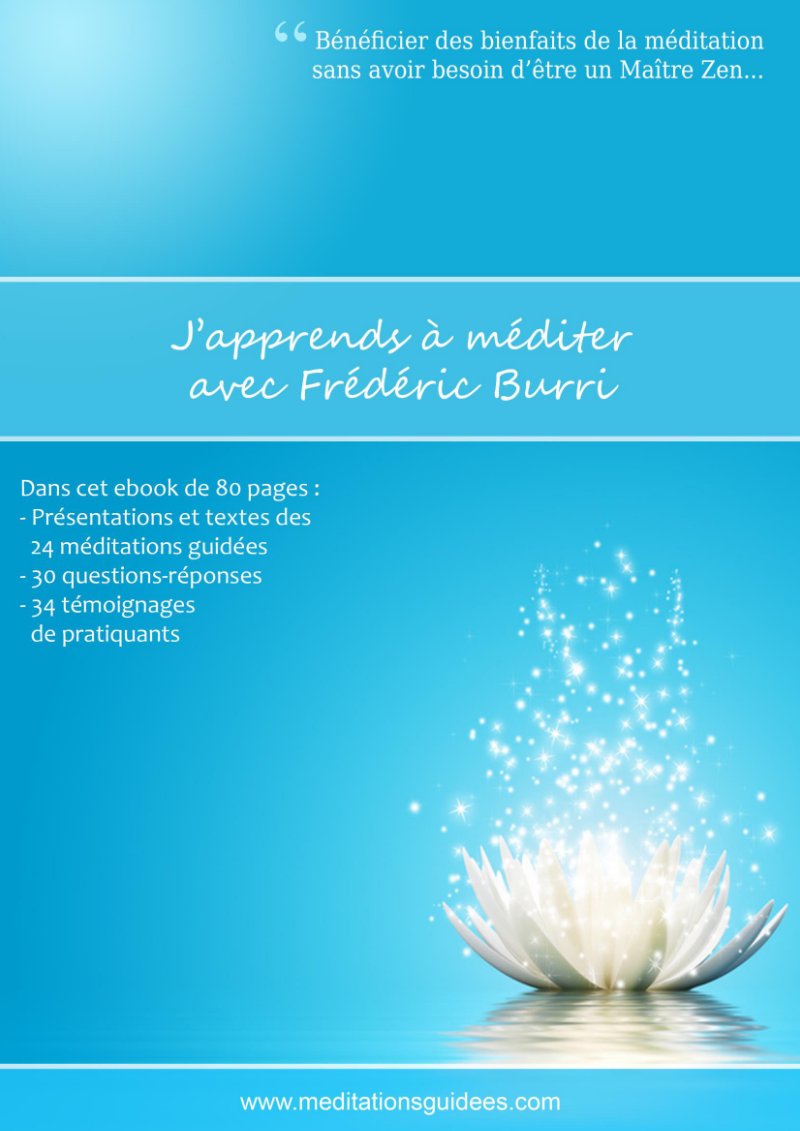
Learning to Meditate
This comprehensive guide introduces the fundamental principles and practical techniques of meditation for both beginners and seasoned practitioners. You'll learn essential practices including proper posture, breathing methods, and focused mental techniques that form the foundation of a stable meditation routine. The manual walks you through creating a supportive meditation environment, identifying and working through common obstacles that interrupt practice, and weaving mindfulness naturally into your everyday life. The guide explores a range of meditation approaches and styles, with hands-on exercises you can adjust to fit your own schedule and circumstances. Step-by-step instructions and straightforward explanations make it easy to build a meaningful meditation practice that cultivates mental clarity, emotional resilience, and genuine well-being. Whether you're looking for stress relief, spiritual development, or deeper self-awareness, this reference book provides accessible, practical guidance for anyone starting or deepening a meditation practice. Table of Contents: - 1. the themes ........ 6 - 1.1. Quick energetic cleansing (17:44) ........ 7 - 1.2. Return to calm (12:18) ........ 11 - 1.3. Quick relaxation (15:53) ........ 14 - 1.4. Sleep aid (18:02) ........ 18 - 1.5. Meditative walk (21:04) ........ 21 - 1.6. True Forgiveness (32:12) ........ 26 - 1.7. The tree of life (23:25) ........ 39 - 1.8. Healing of the wounded inner child (31:01) ........ 45 - 1.9. Abundance (23:55) ........ 52 - 1.10. Nourishing oneself with prâna (19:30) ........ 60 - 1.11. Presence at the hara (17:19) ........ 66 - 1.12. Conscious healing (25:07) ........ 71 - 1.13. Letting go (21:29) ........ 78 - 1.14. Breathing consciously (16:51) ........ 89 - 1.15. Being a Sun in society (18:41) ........ 96 - 1.16. Reharmonization through the Divine Breath (26:07) ........ 100 - 1.17. Recentering and grounding (26:44) ........ 106 - 1.18. Welcoming suffering (23:08) ........ 111 - 1.19. Improving self-image (26:17) ........ 118 - 1.20. Freeing oneself from fear (24:42) ........ 125 - 1.21. Freeing oneself from addiction (10:22) ........ 132 - 1.22. In full consciousness (31:11) ........ 140 - 1.23. In unity with the Light (24:57) ........ 150 - 1.24. Psychic healing protocol (26:16) ........ 154 - 2. questions-answers ........ 166 - 2.1. What is guided meditation, and what are its basic principles? ........ 166 - 2.2. What are the benefits of guided meditation, and of meditation in general? ........ 170 - 2.3. Do guided meditations help achieve Spiritual Realization? ........ 173 - 2.4. Can we heal our emotional wounds through meditation? ........ 176 - 2.5. I feel stirred up after practicing a guided meditation. Why does this happen to me, and what should I do? ........ 179 - 2.6. In what position should one meditate? ........ 181 - 2.7. How to get the most out of guided meditations? ........ 182 - 2.8. Can we create our own guided meditations? ........ 184 - 2.9. What about the use of crystals, incense, essential oils, Tibetan bowls or symbols for example? ........ 185 - 2.10. It's always white light that you ask us to visualize, why not colors? ........ 185 - 2.11. During meditation, I see colors even though my eyes are closed, is this normal, is it dangerous? ........ 186 - 2.12. Why is there no background music? ........ 186 - 2.13. Why don't you use binaural beats, isochronic tones or I-doser type programs? ........ 187 - 2.14. How often should one practice guided meditations? ........ 188 - 2.15. Does guided meditation replace psychotherapy? ........ 188 - 2.16. Can listening to the OM sound alone produce healing? ........ 189 - 2.17. Can guided meditations be beneficial for people with cancer? ........ 190 - 2.18. I fall asleep every time before the end, how can I prevent this? ........ 191 - 2.19. I despair because I can't meditate? ........ 191 - 2.20. I feel like I'm becoming dependent on guided meditations, is this a problem? ........ 194 - 2.21. Why do you favor natural breathing rather than controlled breathing? ........ 195 - 2.22. Why do I feel like sleeping after practicing a guided meditation? ........ 196 - 2.23. When I have to concentrate during the guided meditation, I tense up automatically, why? ........ 196 - 2.24. I never have time to meditate! ........ 197 - 2.25. What is the difference between the meditative state and the trance state? ........ 198 - 2.26. Why do you use the personal pronoun "I" for the guidance? ........ 199 - 2.27. Do you use hypnosis or subliminal messages in guided meditations? ........ 200 - 2.28. Does meditation make us impervious to negative energies? ........ 200 - 2.29. In certain meditations, we are asked to imagine something. What if I can't imagine? ........ 201 - 2.30. During my guided meditations, flashes appear briefly as images, representing people as well as known and unknown places. Can you explain this phenomenon to me? ........ 204 - 2.31. During a guided meditation, I had the impression of "leaving my body", what causes this and how to avoid it? ........ 205 - 2.32. What is the difference between vital energy and "vital breath" (prâna)? ........ 205 - 2.33. Is it true that prâna can only be captured in the alpha state. Can listening to binaural beats used to induce the alpha state promote the absorption of prâna? ........ 207 - 2.34. Sometimes you speak of the capital importance of putting into practice the three keys of opening to prâna, sometimes you say there is nothing else to do but to feel. Isn't this ambivalent? ........ 208 - 2.35. Shouldn't everything related to spirituality be offered for free? ........ 209 - 2.36. Some of your guided meditations are personal development tools. But doesn't personal development conflict with meditation and spirituality? ........ 210 - 2.37. Although I have the intention to welcome my suffering, I can't do it alone, because I'm too afraid of letting go. So what should I do? ........ 211 - 3. testimonials ........ 212 - 4. image credit ........ 224
Popular Education and Social Work: Education Shared
Master's thesis examining the ideological foundations and historical development of popular education and social work as interconnected movements for social change. This research traces how both fields emerged from shared philosophical and moral commitments to emancipation and protection of disadvantaged populations through education. The study unfolds across three main sections: the first establishes the social idea through its three foundational ideological sources—Christian thought, Enlightenment philosophy, and socialist theory—situated within the socio-economic upheaval of industrialization; the second analyzes popular education and social work as distinct yet deeply complementary movements, both grounded in humanist principles and republican ideals; the third investigates protection and emancipation as dual, inseparable missions central to contemporary adult education practice. The thesis demonstrates that both movements draw from a common ideological framework viewing education as essential to democratic participation and social transformation, particularly for those historically excluded from access to knowledge and decision-making.
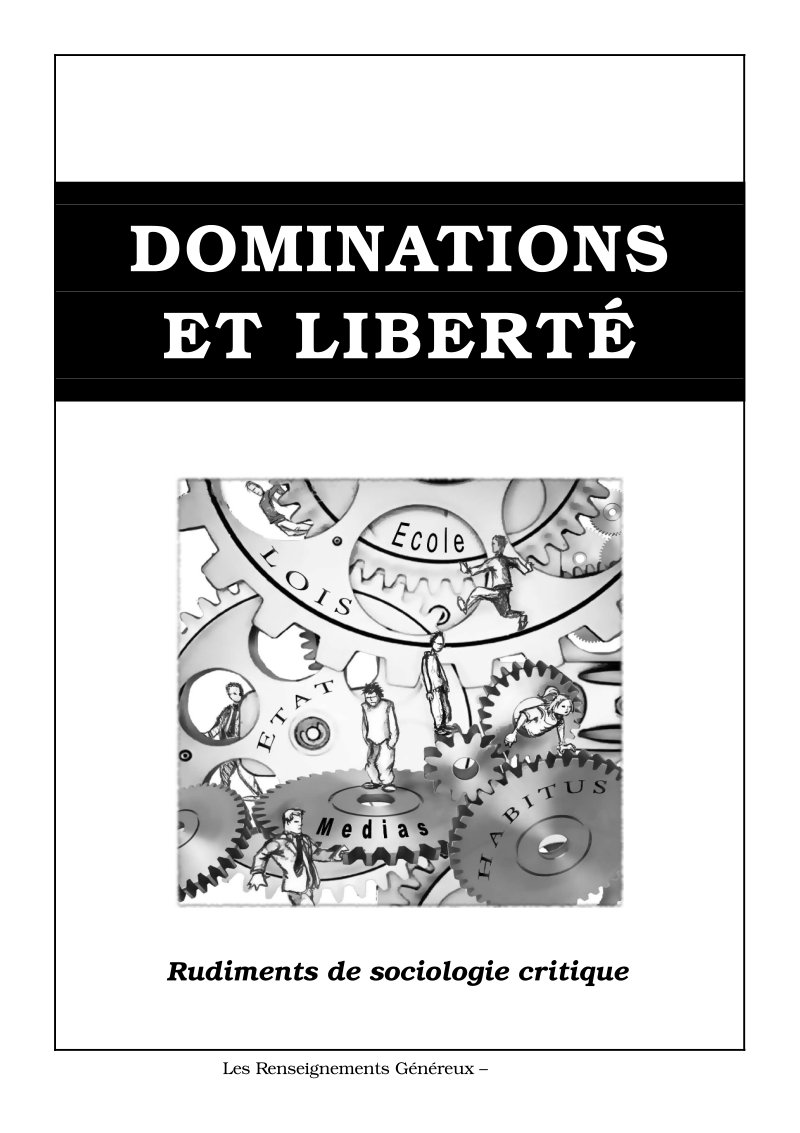
Rudiments of Critical Sociology: Dominations and Freedom
This educational reference work provides a systematic introduction to critical sociology through five interconnected sections covering the discipline's core theoretical foundations. The text begins by examining socialization—the fundamental processes through which individuals internalize social norms via family structures, formal education, and cultural transmission mechanisms. It then traces how societies perpetuate themselves through these reproductive cycles. The second section analyzes social dynamics in depth, exploring how social reproduction operates and how cultural, economic, and symbolic capital circulate among different social groups. The third section investigates social distinction, revealing the mechanisms by which groups construct and preserve their collective identity through deliberate differentiation from others. A dedicated section introduces habitus as a central analytical framework for interpreting patterns of social behavior and practice. The work concludes by clarifying the core mission of critical sociology as a discipline—to decode and interrogate the structural foundations of social domination. Throughout, the text demonstrates how everyday social practices, lifestyle choices, and patterns of cultural consumption function as instruments that perpetuate social hierarchies and reproduce inequality across generations. Table of Contents: - I Socialization .... page 3 - II Social dynamics .... page 5 - III Social classes .... page 14 - IV The concept of habitus .... page 18 - V The goals of critical sociology .... page 22
Rumors as a Social Influence Phenomenon
This comprehensive academic study examines rumors as a significant social influence phenomenon, analyzing how they originate, circulate, and shape individuals and communities within social structures. The work explores the psychological and sociological mechanisms underlying rumor propagation—uncertainty, anxiety, collective belief formation—and traces how information spreads through social networks with measurable consequences for group cohesion. The resource provides theoretical frameworks for understanding rumor behavior, the role of interpersonal communication in amplifying or dampening spread, and the mechanisms by which rumors influence public opinion and group perception. It distinguishes rumors from other forms of misinformation, examining what makes rumors particularly effective as instruments of social influence and collective action. Essential for researchers, students, and professionals studying collective behavior, communication processes, and social psychology. Table of Contents: - Contents - Chapter 1 - Rumors as a Social Influence Phenomenon - 1. What Is a Rumor? - 2. Are Rumors Credible? Rumors and Disinformation - 3. Why Study Rumors? - Chapter 2 - Rumors and Information - 1. Rumor and Uncertainty - 2. Uncertainty and the Logic of Situations - 3. Uncertainty and Ambiguity - 4. Uncertainty and Anxiety - Chapter 3 - Dynamics of Belief and Disbelief - 1. Social Proof - 2. Dynamics of Plausibility Assessment - Chapter 4 - Rumor Content - Categorizing Content - 1. Content and Social Structure: Intergroup Rumors - Chapter 5 - Rumor Transmission - 1. Spreading and Morphing - 2. Network Factors that Facilitate (or Impede) Spread - 3. Content and Spread - Epilogue - References

Secularism in School: A Practical Guide
This practical handbook from the French Ministry of National Education serves as an essential reference for applying secularism within school systems. The guide addresses real-world situations educators encounter daily, offering concrete strategies, legal frameworks, and actionable resources for school staff managing issues around religious expression and republican values. It covers how secularism applies across all members of the school community—students, teachers, administrators, parents, and visiting professionals—with tailored guidance for each group. Built on two decades of legislation since the 2004 law, the handbook incorporates recommendations from the Council of Wise Persons on Secularism and Republican Values, providing both foundational understanding of French secular principles and practical solutions for navigating contemporary challenges in schools. Detailed fiches address specific situations and offer straightforward tools for addressing teaching refusals, community concerns, and maintaining the republican ideals of liberty, equality, and fraternity in educational settings. Table of Contents: - Glossary .... 4 - Preface .... 6 - Introduction .... 9 - Presentation of the Vademecum .... 11 - 1. General Scope Fact Sheets .... 14 - Fact Sheet 1. Promoting and enforcing the principle of secularism in primary and secondary education .... 16 - Fact Sheet 2. Mobilizing the educational community .... 22 - 2. Resource Fact Sheets .... 28 - Students .... 31 - Staff .... 101 - Parents of students .... 121 - External contributors .... 129 - Annexes .... 134

Sex Education in Schools: Prevention to Early Sexualization
Comprehensive analysis examining sex education in French schools, focusing on child protection and developmental appropriateness. This 189-page report by SOS Education investigates risks of early sexualization of children and adolescents through school-based sex education programs. The document provides scientific examination of child development from infancy through adolescence, detailing how premature exposure to sexual content can cause psychological harm. It includes twelve concrete case studies documenting problematic teaching practices observed in French schools, analysis of official curricula and their implementation, examination of state-promoted sexual content directed at children, and legal framework assessment. The report emphasizes the importance of age-appropriate education aligned with cognitive and emotional development stages. It offers evidence-based recommendations for school administrators, teachers, parents, and policymakers seeking to balance health education with child protection. Expert contributors include pediatricians, child psychologists, and legal specialists in child protection. The analysis challenges current approaches promoting early sexualization under progressive ideology while advocating for education centered on child welfare and proper development. Table of Contents: - Acknowledgements .... 4 - Introduction .... 8 - 1. understanding the child to not harm them .... 12 - 1.1. Infantile sexuality: a pedophile fantasy? .... 13 - 1.2. The development of the child .... 16 - 1.3. Preserving childhood and attachment bonds .... 22 - 1.4. The traumatogenic consequences of sexual reality imposed on the child .... 29 - 1.5. Key points .... 36 - 2. understanding adolescence to help adolescents .... 37 - 2.1. Understanding adolescence .... 38 - 2.2. Sexed identity, this difference called equality... .... 42 - 2.3. Being an adolescent in a society of sex and pleasure .... 48 - 2.4. Rape culture and pornification of relationships, the ravages of porn .... 51 - 2.5. The adolescent, an adult in appearance, but without the capacity for discernment .... 58 - 2.6. Sex education for adolescents .... 63 - 2.7. Key points .... 67 - 3. concrete cases .... 68 - 3.1. "For pleasure a girl sucks the boy's penis" .... 69 - 3.2. "Boys press, press, press, and the sperm comes out" .... 70 - 3.3. "The woman mounts the man and his penis swells" .... 71 - 3.4. Abused at 5, forced at 14 to put a condom on a fake penis .... 72 - 3.5. "Sexual intercourse is possible through the anus and vagina" .... 73 - 3.6. Masturbation in middle section of preschool .... 74 - 3.7. "Sucking is like sucking a Haribo candy, it's pleasure" .... 76 - 3.8. Forced to watch a woman's genitals during childbirth .... 77 - 3.9. The nurse put a condom on a plastic bottle .... 78 - 3.10. "A little girl can be born with a vagina or a penis" .... 78 - 3.11. "You can pleasure yourself through the buttocks" .... 79 - 3.12. "Sperm: whitish liquid emitted by the penis" .... 80 - 3.13. Testimonies .... 81 - 4. sex education in the school setting .... 83 - 4.1. Reference texts .... 84 - 4.2. Sex education: caution, minefield! .... 85 - 4.3. From prevention to pleasure sexuality and gender ideology .... 96 - 4.4. Objectives unrelated to sex education .... 98 - 4.5. Intersectionality and eco-sexo-citizenship .... 103 - 4.6. Ethical principles and wishful thinking .... 105 - 4.7. Technocratic excess .... 110 - 4.8. Key points .... 113 - 5. the state, sexual promoter .... 114 - 5.1. It is taboo to have taboos .... 115 - 5.2. Childhood and youth overexposed .... 115 - 5.3. The State as sexual promoter .... 116 - 5.4. State sexuality: from bus shelters to information sites for children .... 117 - 5.5. Social networks, new source of information for 11-24 year olds .... 123 - 5.6. Key points .... 126 - 6. legal obligations and fragilities .... 127 - 6.1. From French law to flexible international law .... 128 - 6.2. Students concerned and mandatory nature .... 129 - 6.3. Official content and theoretical implementation .... 130 - 6.4. Legal fragilities .... 132 - 6.5. Key points .... 135 - 7. recommendations .... 136 - 7.1. Guiding principles .... 137 - 7.2. Title by grade level and choice of terms used .... 137 - 7.3. Programs - what should and should not be done .... 138 - 7.4. Content by age group - what should and should not be done .... 138 - 7.5. Organization, role of school health and competencies of speakers .... 140 - 7.6. The role of parents .... 142 - 7.7. Key points among the 130 recommendations .... 144 - 8. conclusion .... 145 - 9. annexes .... 149 - 9.1. WHO Matrix - 0 to 15 years .... 150 - 9.2. Supplement on cognitive development of children .... 165 - 9.3. Most searched sexuality terms by French speakers on TikTok .... 169 - 9.4. Letter from Pap Ndiaye to the Higher Council of Programs .... 173 - 9.5. Letter from SOS Education to the President of the Higher Council of Programs .... 175 - 10. bibliography & reference texts .... 182

Sexual Violence Against Children: We Believe You - CIIVISE Report
Comprehensive public report from the Independent Commission on Incest and Sexual Violence Against Children (CIIVISE), published November 2023. This 756-page document presents three years of investigation and evidence-based analysis into sexual violence affecting children in France. The report draws on thousands of victim testimonies, institutional audits, expert consultations, and field investigations across multiple regions to establish detailed findings on prevalence, patterns, and institutional gaps in child protection systems. It documents systemic vulnerabilities in detection and intervention mechanisms across social services, education, healthcare, and justice sectors, and identifies institutional failures that have allowed abuse to persist. The commission provides actionable policy recommendations for prevention strategies, victim support services, professional training standards, and mechanisms for institutional accountability. A central emphasis throughout is the imperative to believe and support victims while establishing comprehensive protective frameworks that strengthen safeguarding across all systems responsible for child welfare.

State of Human Rights in Belgium 2024 Report
Comprehensive annual report by the Ligue des Droits Humains documenting the state of human rights in Belgium during 2024. This essential reference work examines critical pressures on democratic institutions and fundamental freedoms, including the expanding influence of far-right political movements across Europe and their impact within Belgium. The report addresses press freedom, migration and asylum policies, algorithmic surveillance systems, police conduct and accountability, drug policy frameworks, social welfare protections, and environmental justice concerns. It analyzes the weakening of democratic safeguards, violations of core rights, and how European legislation on border control and asylum procedures is being implemented on the ground. Detailed assessments show where human rights protections are strengthened or compromised through government action, judicial rulings, and civil society intervention. Indispensable for anyone seeking to understand the contemporary human rights landscape in Belgium and the broader European context. Table of Contents: - INTRODUCTION Storm warning on human rights by Pierre-Arnaud Perrouty .... 02 - Far right and human rights by Sibylle Gioe .... 05 - Freedom of the press: reminder of fundamental (rights) by Jil Theunissen .... 09 - Legislative war against migrants, still and always? by Noémi Desguin .... 15 - These ECHR rulings gathering dust in Belgium's drawers by Aline Wavreille .... 19 - Support for Gaza: from words to action by Manuel Lambert .... 24 - Algorithmic surveillance of bodies and faces: a decisive year 2024? by Rémy Farge .... 30 - What future for predictive policing in Belgium? by Corentin Debailleul .... 35 - War on drugs or fight for dignity? by Saskia Simon .... 40 - The Arizona, the Far-West of social policy? by Yves Martens .... 45 - The Farmer Case: a legal battle for just transition by Matthias Petel and Céline Romainville .... 49 - CONCLUSION Resisting defeatism to defend human rights by Sibylle Gioe .... 53 - Retrospective 2024 .... 55
Summit Crosses in the Northern French Alps: Sacred History 1850-Present
This comprehensive academic thesis examines the history and cultural significance of cross installations on mountain summits in the Northern French Alps spanning 1850 to the present day. Structured across three distinct historical periods—The Awakening (1850-1870), Growth (1880-1960), and Maturity (1960-2019)—the study traces how sacred symbols came to dominate Alpine peaks and the religious reconquest of mountain spaces. The thesis investigates the motivations behind cross erections, the complex interplay between local spiritual practices and expanding tourism, and how these installations transformed the meaning of Alpine summits over time. Drawing on representations, cartography, and cultural analysis, the work demonstrates how local populations, clergy, administrators, and travelers constructed and negotiated the sacred meaning of these high places according to their own spiritual and material concerns. The study addresses notable conflicts surrounding these religious symbols, including documented vandalism incidents in the Chartreuse massif around 2000 and ongoing contemporary debates about the role of religious symbols in shared public spaces. By bridging religious history, landscape representation, and secular modernity, this thesis provides essential context for understanding how spiritual geography shaped the French Alps and how that landscape continues to reflect broader questions about faith, heritage, and social change. Table of Contents: - Acknowledgements .... 3 - Table of Contents .... 4 - Introduction .... 6 - Part I. The Awakening (1850-1870) Summit Crosses and the Conquest of High Places .... 14 - Chapter 1. Representing the Mountain in 1850: A Challenge? .... 14 - Words to Tame the Summits .... 14 - Staging to Capture the Summits .... 23 - Cartography to See the Summits .... 34 - Chapter 2: Summit Crosses in the Time of Alpine Recatholicization .... 42 - Domesticating the High Places: The Summit Cross Against the Devil .... 42 - Completing the Christianization of the Alps: The Cross of Grand Som (Chartreuse, 2,026 m) .... 54 - Reconquering the Faithful Through the Cross .... 60 - Chapter 3: Of Men and Gods at the Summit .... 74 - Conquering the Summits .... 74 - The Cross of Vieux Chaillol (Écrins, 3,163 m): The Spiritual Conquest of the Summits .... 82 - The Cross of Dent du Nivolet (Bauges, 1,547 m): An Urban Summit Cross? .... 92 - Contesting the Summit Cross? Le Châtel or Bonnet de Calvin (Dévoluy, 1,933 m) .... 103 - Conclusion. 1850-1870: A Foundational Sequence .... 109 - Part II. Growth (1880-1960) Building Summit Crosses .... 110 - Chapter 4: The Era of Sacred Summit Construction Sites .... 110 - An Inspired Mountain for a New Century? Permanence of a Tradition .... 110 - Building Crosses at the Beginning of the Twentieth Century .... 117 - Who Are the "Cross Builders"? .... 143 - Chapter 5: The Summit Cross as Guide (1920-1960) .... 148 - "Everything That Climbs Converges": The Summit Cross and the Mountain as Ideal .... 148 - Summit Crosses for Remembrance .... 163 - Conclusion. 1880-1960: The Spring of Summit Crosses .... 174 - Part III. Maturity (1960-2019) Summit Crosses and Secularization .... 175 - Chapter 6. Placing New Crosses on the Summits .... 175 - Erecting Summit Crosses: A Movement That Continues .... 175 - The Summit Cross and Mass Tourism: Toward a Secularization of the Peaks? .... 190 - Chapter 7. Replacing or Rejecting Summit Crosses? .... 193 - Replacing Summit Crosses: A Generalizing Practice .... 193 - Contesting Summit Crosses .... 212 - Conclusion .... 222 - Sources .... 227 - Printed Sources .... 227 - Printed Sources Available Online .... 229 - Press and Journals Consulted Online .... 232 - Sources Available Online .... 233 - Websites .... 233 - Bibliography .... 234 - Religious Fact .... 234 - Representation .... 236 - Profane and Sacred .... 238 - Appendices .... 240 - Table of Contents .... 296
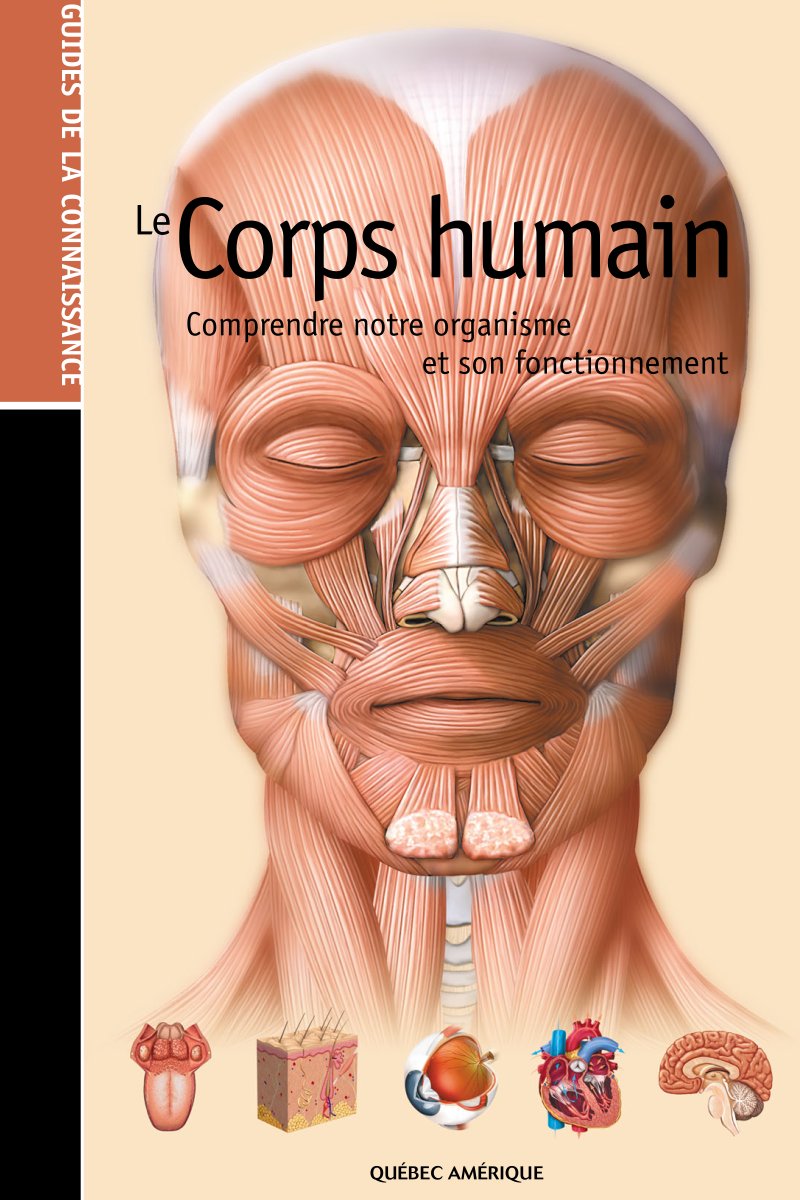
The Human Body: Understanding Our Organism and Its Functioning
A comprehensive illustrated reference guide to the complete structure and functioning of the human body, covering anatomy and physiology across all levels of biological organization. This educational resource begins with the fundamental units of life—the approximately 60 trillion cells that make up the human organism—examining their structure, genetic material contained in chromosomes and DNA, and metabolic activities. The guide then systematically explores the body's major structural and functional systems: the skeletal system, muscular system, and joints, followed by the skin as the body's largest organ. Moving deeper into systemic function, it covers the nervous system with detailed examination of neurons and brain architecture, sensory mechanisms of vision, hearing, taste, smell, and touch, the circulatory and lymphatic systems responsible for transport and immunity, the mechanics of respiration, and the digestive system's role in nutrition and metabolism. Additional sections address the endocrine system for hormonal regulation, the urinary system for waste elimination, and human reproduction including embryonic development and prenatal physiology. Throughout, detailed anatomical illustrations, cross-sections, and functional diagrams demonstrate how individual organs integrate within their respective systems and how all systems work together to maintain homeostasis. Developed under the guidance of QA International with medical expertise, this reference serves as an authoritative foundation for understanding how the human body operates at every scale. Table of Contents: - The matter of the body .... 6 - The human cell .... 8 - Chromosomes and DNA .... 10 - Cellular activity .... 12 - Body tissues .... 14 - The architecture of the body .... 16 - The skin .... 18 - Bone structure .... 20 - Bone growth .... 22 - The human skeleton .... 24 - Types of bones .... 26 - The head .... 27 - The spinal column .... 28 - The hand and foot .... 30 - Joints .... 32 - Skeletal muscles .... 34 - Muscle tissue .... 36 - Muscles of the head .... 38 - Action of skeletal muscles .... 40 - Hand movements .... 41 - The nervous system .... 42 - Neurons .... 44 - The central nervous system .... 46 - The encephalon .... 48 - The brain .... 50 - The peripheral nervous system .... 52 - Motor functions of the nervous system .... 54 - The five senses .... 56 - Touch .... 58 - The eye .... 60 - Vision .... 62 - Organs of hearing .... 64 - Sound perception .... 66 - Balance .... 67 - Taste .... 68 - Taste receptors .... 70 - Smell .... 72 - Blood circulation .... 74 - Blood .... 76 - The cardiovascular system .... 78 - Arteries and veins .... 80 - The heart .... 82 - The cardiac cycle .... 84 - The lymphatic system .... 86 - Immunity .... 88 - The endocrine system .... 90 - The hypothalamus and pituitary gland .... 92 - The urinary system .... 94 - Respiration and nutrition .... 96 - The respiratory system .... 98 - Respiration .... 100 - Speech .... 102 - The digestive system .... 104 - Teeth .... 106 - The stomach .... 108 - The intestines .... 109 - The liver, pancreas and gallbladder .... 110 - Reproduction .... 112 - Male reproductive organs .... 114 - Female reproductive organs .... 116 - Fertilization .... 118 - Embryonic life .... 120 - Maternity .... 122 - Glossary .... 124 - Index .... 126
The Obsolescence of Man: On the Soul in the Age of the Second Industrial Revolution
Originally published in German in 1956 as 'Die Antiquiertheit des Menschen', this landmark philosophical work presents a searching critique of human obsolescence in the technological age. The argument unfolds through four closely reasoned essays: how mass media reshapes consciousness, how nuclear weapons paralyze moral will, how unemployment erodes human purpose, and how manufactured spectacle supplants authentic reality. Central is the concept of 'blindness to the apocalypse'—humanity's inability to grasp the catastrophic implications of contemporary technology despite living under their shadow. What makes this work enduringly vital is its unflinching examination of how television and other technological systems colonize human experience from within, gradually diminishing our capacity for genuine agency, critical thought, and authentic living. A philosophical manual for understanding the spiritual and existential costs of technological progress.

The Rhetoric of the Honest Man: Writing and Discourse Guide
A comprehensive rhetorical treatise published in Amsterdam designed to teach the practical communication skills needed to cultivate the honest man after formal education. This practical guide addresses the real-world knowledge typically missing from academic curricula, focusing on letter writing, composing various forms of discourse, and delivering eloquent speeches. The manual offers instruction in mastering the French language and studying the techniques of accomplished poets through careful imitation. Throughout, exemplary passages from celebrated authors demonstrate how to apply the rhetorical principles taught. The volume concludes with an extensive catalog of recommended books for assembling a gentleman's library, providing guidance on selecting quality works across all branches of knowledge. Rigorous in its standards yet free from pedantic school methodology, this writing and discourse guide remains an invaluable reference for anyone seeking to develop refined communication and intellectual cultivation.
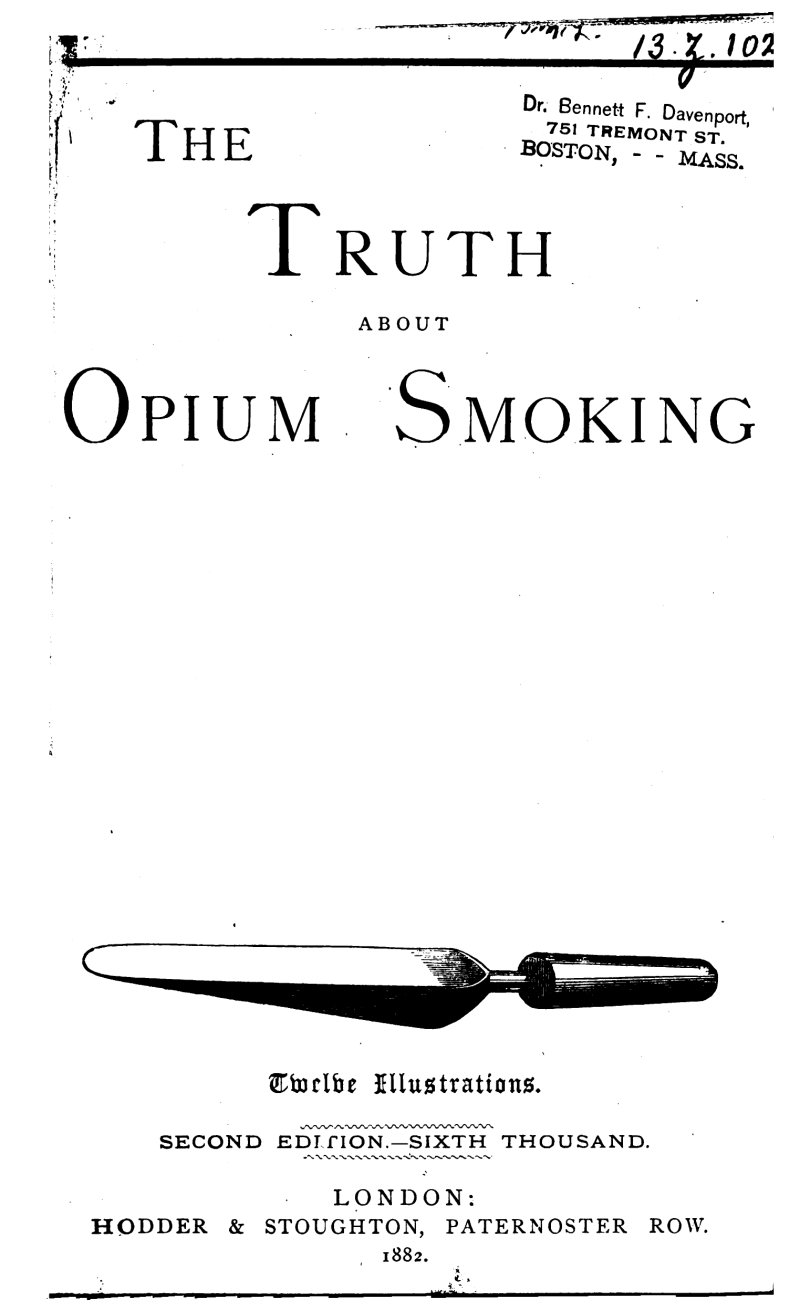
The Truth About Opium Smoking
Second edition from 1882 presenting conference proceedings on opium smoking practices, firsthand accounts from missionaries and medical practitioners who worked in China, and documented arguments surrounding the British opium trade. The volume includes period illustrations depicting opium production and consumption methods, offering a historical record of 19th-century perspectives on the trade and its social effects. Table of Contents: - Introduction .... 5-16 - Proceedings at Conference on Opium-Smoking .... 17-30 - Speakers.—Lord Polwarth (chairman); Rev. W. H. Collins, M.R.C.S.; Dr. Gauld; Dr. Maxwell; Dr. Galt; Rev. A. E. Moule; Rev. J. Sadler, and others. - Proceedings at Public Meeting on Opium-Smoking. - Testimony of Rev. David Hill .... 31 - Sixteen years missionary in China. - Testimony of Rev. Arthur E. Moule, B.D. .... 34 - Twenty-one years missionary in China. - Testimony of Dr. Gauld .... 37 - Sixteen years medical missionary in China. - Testimony of J. Galt, Esq., F.R.C.S., Ed. .... 40 - Formerly in charge of the Church Missionary Society's Opium Hospital at Hang-chow. - Testimony of Rev. F. W. Baller .... 42 - Eight years missionary in China. - Testimony of Rev. W. H. Collins, M.R.C.S. .... 44 - Twenty-three years medical missionary in China. - Testimony of Rev. James Sadler .... 46 - Sixteen years missionary to the Chinese. - Speech of Lord Polwarth .... 48 - Speech of Mr. Donald Matheson .... 50 - Speech of Mr. T. A. Denny .... 50 - Speech of Rev. J. McCarthy .... 52 - Testimony of James L. Maxwell, M.A., M.D. .... 52 - Eight years medical missionary in China. - Testimony of Rev. J. McCarthy .... 56 - Twelve years missionary in China. - Testimony of Rev. Griffith John .... 61 - Twenty-six years missionary in China. - Appendix. - Answers to Excuses for the Opium Trade - Excuse 1. Opium-smoking not very injurious .... 65 - Testimony of the Chinese—British Officials—Medical Men. - Excuse 2. The Chinese not sincere in their desire to suppress opium-smoking .... 75 - Testimony of Sir Rutherford Alcock—Li Hung-chang—the Chinese—Growth of opium in China no proof of insincerity—Testimony of Sir Rutherford Alcock and others. - Excuse 3. The British Government has not forced China to admit opium .... 81 - Testimony of Sir Rutherford Alcock—Commissioner Kwei-liang—Sir Thomas Wade—Lord Elgin—Rev. H. Grattan Guinness—Sir Edward Fry—Rev. James Johnston. - Excuse 4. If opium was forced upon China, we are not responsible for what others did long ago .... 85 - Sir Edward Fry—Rev. A. S. Thelwall, M.A. - Excuse 5. If we do not send opium to China, others will .... 86 - Excuse 6. That opium-smoking in China is not worse than intoxicating drink in England .... 86 - The Opium Monopoly .... 87 - A proposal; very candid, if not very wise—A larger revenue with less labour—An erroneous issue. - The Opium Trade and British Commerce .... 89 - Injurious to British Commerce, by David M'Laren, Esq.—Cotton Goods and the Opium Trade—Rev. Goodeve Mabbs—London Bankers on the Opium Trade—Mr. S. Manders—Dr. Dudgeon. - The Opium Trade as Now Carried on a National Sin, Which Must Bring Retribution .... 94 - Dr. Norman Macleod—Sir Arthur Cotton—The late M'Leod Wylie, Esq.—Cardinal Manning. - Protest of the Late R. Montgomery Martin, Esq. .... 97 - Letter from Sir Arthur Cotton .... 99 - Important Testimonies .... 102 - Archbishop of Canterbury—Archbishop of York—Bishop of Madras—Earl of Shaftesbury—The late Dr. Punshon—Mr. Henry Richard, M.P. - Parliamentary Action .... 106 - Sir J. W. Pease's Notice of Motion—Letters from the Archbishop of York—The Bishop of Durham—The Bishop of Liverpool—The Bishop of Exeter. - Signs of Progress in Public Enlightenment .... 108 - The chief Excuse. India cannot do without the opium revenue .... 118 - Illustrations. - An Opium-Smoker .... 30 - Li Hung-chang .... 64 - Chinese Officials .... 67 - The Poppy .... 79 - Chinese Merchants .... 91 - Crude Opium exuding from the Green Poppy-Head .... 111 - The Examining Hall .... 112 - The Mixing Room .... 113 - The Balling Room .... 114 - The Drying Room .... 115 - The Stacking Room .... 116 - Opium Fleet descending the Ganges .... 117
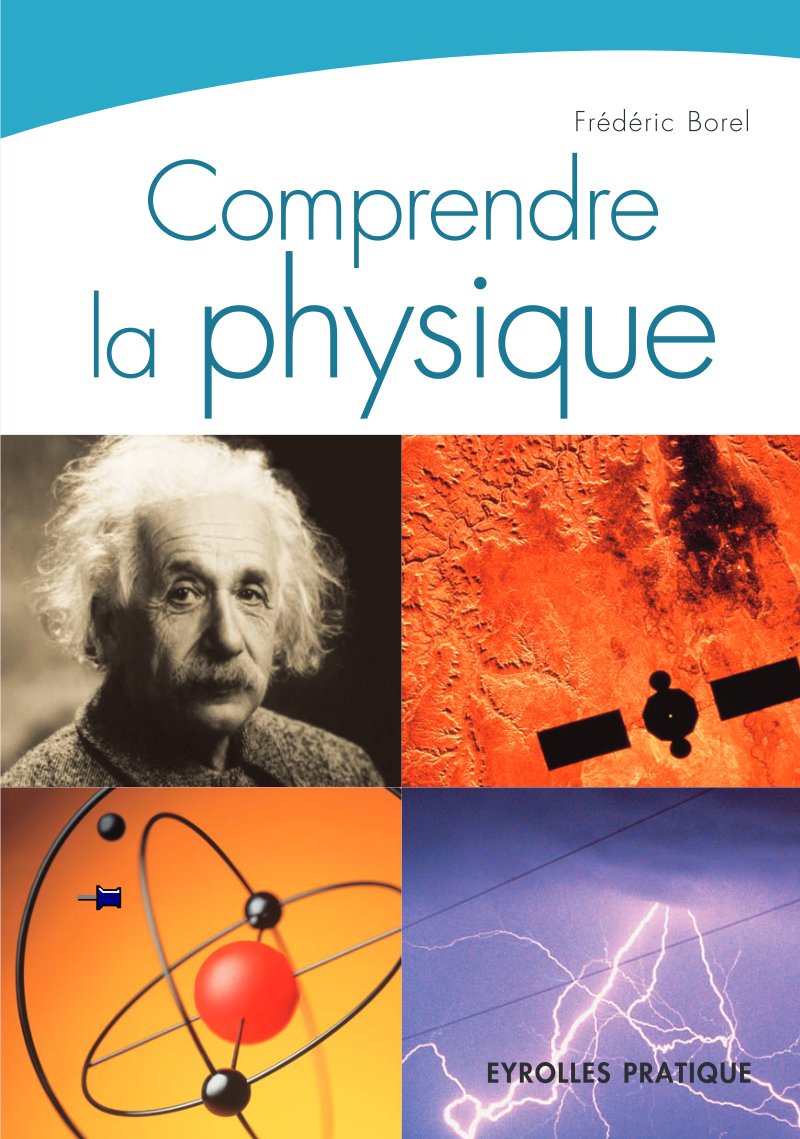
Understanding Physics: Illustrated Multiple Choice Questions
A comprehensive and engaging educational reference featuring 160 illustrated multiple-choice questions designed to demystify fundamental physics concepts and the key physicists who advanced the discipline. This accessible learning guide presents physics through concrete everyday examples and historical anecdotes, making abstract principles tangible for readers of all ages. Each question-answer pair is supported by detailed explanations and numerous illustrative diagrams that clarify the reasoning behind each response. The content spans seven major domains of physical science: astronomy, electromagnetism, mechanics, optics, thermodynamics, structure of matter, and chemistry. This reference transforms physics from an intimidating subject into an enjoyable exploration of scientific principles. The interactive multiple-choice format encourages active learning while building solid foundational knowledge in the physics governing everyday phenomena such as boiling water, electrical heating, falling objects, and photography. Table of Contents: - Introduction .... 7 - To Begin .... 9 - Astronomy .... 25 - Electromagnetism .... 51 - Mechanics .... 73 - Optics .... 97 - Thermodynamics .... 117 - Structure of Matter .... 133 - Chemistry .... 153 - Glossary .... 181 - Index .... 187
Vietnam: A History of Cultural Transfers
This comprehensive academic work examines Vietnam as one of history's most significant sites of cultural encounter and exchange, revealing the intricate interactions between civilizations that have shaped the region from ancient times through the modern era. The study transcends narrow interpretations of Vietnam as merely a battlefield or colonial territory, instead positioning it as a genuine crucible where diverse traditions have met, merged, and transformed one another. The research traces how Chinese and Indian cultural influences interacted in antiquity and evolved through subsequent historical periods, documenting the layered complexity of these transnational exchanges. Contributors spanning twenty-one academic disciplines—including literature, fine arts, religious studies, education, science, and archival research—provide genuinely multidisciplinary perspectives that illuminate cultural transfers across visual arts, literary traditions, religious phenomena, educational systems, and the development of knowledge itself. Originally presented at a colloquium held jointly at the École Normale Supérieure and the Bibliothèque Nationale de France in June 2014 as part of the France-Vietnam cultural year, this landmark reference work establishes Vietnam's universal significance within global history and offers essential insights into how civilizations shape one another through sustained cultural dialogue.
War in Chechnya, Exile and Diaspora: Chechen Community Structures Abroad
This doctoral thesis presents a comprehensive examination of how Chechen communities structured themselves abroad during and after the wars in Chechnya between 1997 and 2007. Drawing on extensive fieldwork conducted across Turkey, Russia, the South Caucasus, and Europe, the research traces the organizational evolution of refugee and exile populations as they established themselves in foreign territories. The study analyzes migratory patterns and settlement dynamics in host countries, documenting the emergence of proto-diasporic organizations and their gradual transformation into formal diaspora structures. A central focus is the political decomposition within refugee communities and the mechanisms by which dispersed populations reconstructed identity and social cohesion under conditions of displacement. The thesis situates contemporary Chechen exile within broader historical context, drawing connections to earlier conflicts and forced deportations that had already shaped collective memory and survival strategies. By examining diaspora as both a social phenomenon and a novel form of global political actor, the work illuminates how war-displaced communities navigate identity formation, integration, and the complexities of long-term exile. Table of Contents: - Acknowledgements .... 5 - Table of contents .... 7 - Rules of transliteration and transcription .... 8 - Introduction .... 9 - Destructuring of the chechen republic .... 35 - Chechens dispossessed of their destiny (1996-2005) .... 37 - Chechnya left to itself (2005-2007) .... 76 - Diasporic genealogies .... 99 - Migratory paths and conditions of settlement .... 101 - The Chechen issue within host States .... 140 - Becoming Chechen again: emergence of protodiasporic structures .... 173 - The constituted diaspora: a new global actor .... 245 - Political decomposition of refugee communities .... 247 - The diaspora: source of renewal .... 318 - Conclusion .... 375 - Resources .... 381 - Interlocutors .... 381 - Bibliography .... 397 - Table of contents .... 413 - Appendices .... 417
Yi King: The Book of Changes - Complete Translation
This is the complete French translation of the Yi King (I Ching), one of the oldest texts in Chinese literature, translated by Paul-Louis-Félix Philastre (1837-1902). Originally published in 1885 in Paris, this comprehensive reference work contains all 64 hexagrams with their associated formulas and commentaries. The text includes the foundational work of Wen Wang, the commentaries of Tsheou Kong on individual lines, and the extensive annotations of Khong Tse (Confucius). The translation provides access to the classical Chinese philosophical system based on the observation of celestial phenomena and lunar phases, as interpreted through trigrammatic and hexagrammatic symbols. The introduction discusses the historical origins, authorship debates, and the astronomical foundations underlying the hexagrams. Table of Contents: - Note css - Introduction - Conclusion - Annexed formulas (1 - 2) - Postface - Koua: Definitions - Order - Oppositions - Table - Analytical table FIRST PART - 1. Khien, activity - 2. Khouen, passivity - 3. Tshouen, birth of beings - 4. Mong, development of intelligence - 5. Su, waiting - 6. Song, doubt - 7. Shi, grouping of the crowd - 8. Pi, association - 9. Siao tshou, small stop - 10. Li, ritual rules - 11. Thae, prosperity - 12. P'i, decadence - 13. Thong jen, identity of men - 14. Tae yeou, great possession - 15. Khien, modesty - 16. Yu, satisfaction - 17. Souei, training and following - 18. Kou, causes - 19. Lin, troubles and surveillance - 20. Kouan, object of observation - 21. She ho, cut short the error - 22. Pi, adorn and regularize - 23. Po, wear away gradually, decline - 24. Fou, return in opposite direction - 25. Wou wang, absence of irregularity - 26. Tae tsou, great stop - 27. Yi, nourishment - 28. Tae kuo, what is great crossing - 29. Khan, fall into the abyss - 30. Li, junction and separation SECOND PART - 31. Hien, influence - 32. Heng, perpetuity - 33. Thouen, withdraw backward - 34. Ta tshang, perfect flourishing - 35. Tsin, progression forward - 36. Ming yi, injury - 37. Kia jen, men of the family - 38. Khouei, opposition - 39. Kien, difficulty - 40. Kiae, deliverance - 41. Souen, decrease - 42. Yi, increase - 43. Kouae, determination - 44. Keou, encounter (conjunction) - 45. Tsouei, gathering, reunion - 46. Sheng, birth, elevation - 47. Khouen, misery - 48. Tsing, the well - 49. Ko, modify, change - 50. Ting, tripod - 51. Tshen, the object, the utensil - 52. Ken, the stop - 53. Tsien, progression forward - 54. Kouei mei, marriage - 55. Fong, grandeur - 56. Lou, traveler, stranger - 57. Souen, enter - 58. Touei, please - 59. Hoan, separation - 60. Tsie, define, regulate - 61. Tshong fou, confidence, certitude - 62. Siao kuo, small excess - 63. Ki tsi, already established - 64. Vi tsi, not yet established
Zen! Meditation for Dummies
A comprehensive guide to meditation from the popular For Dummies series, designed to make mindfulness practices accessible to complete beginners. This practical manual covers the fundamentals of meditation while demystifying common misconceptions about the practice. Readers will discover various meditation traditions including Buddhist, Hindu, Christian, Jewish, and Sufi approaches, understanding how each offers unique perspectives on inner work. The guide provides detailed instructions on proper posture, breathing techniques, and creating a dedicated meditation space suited to your needs. You'll learn about the physiological and psychological benefits of regular practice, from stress reduction and emotional wellness to improved focus and mental clarity. The book tackles common obstacles head-on—drowsiness, restlessness, boredom, and scattered thoughts—with practical, tested solutions for working through them. Special focus is given to managing difficult emotions and breaking habitual thought patterns through consistent meditation practice. Key topics include developing concentration, cultivating mindful awareness, and building a sustainable daily routine that fits your life. Step-by-step exercises throughout help you progressively relax your body and calm your mind. The guide emphasizes discipline, perseverance, and the art of letting go as essential foundations for deepening your practice. Whether you're seeking stress relief, greater self-awareness, or a more grounded approach to daily life, this accessible reference supports both beginners and those ready to strengthen an existing meditation practice. Table of Contents: - Title Page - Copyright Page - Introduction - About this book - How to use this book - How is this book organized? - Part One: Meeting meditation - Part Two: This time, let's go - Part Three: Troubleshooting and adjustments - Part Four: Meditation in action - Part Five: The Part of Tens - Icons used in this book - Part One - Meeting meditation - Chapter 1 - Meditation: what it is and what it isn't - The journey toward meditation - The different paths leading to the summit - What's at the summit - and at the peak of other mountains encountered along the way? - The taste of pure mountain water - There's no place like home - and you're already there! - Working with awareness: the secret of meditation - Working on concentration - Opening to receptive awareness - Accessing better inner vision through contemplation - Cultivating positive and healthy states of mind - False journeys toward meditation - Chapter 2 - Meditation: what's it for? - How life leads to meditation - The myth of the perfect life - When everything falls apart - Managing difficult postmodern situations - Four popular "solutions" that don't really work - How to survive the 21st century - with meditation - A cutting-edge technology for mind and heart - The psychophysiological benefits of meditation - Eleven more great reasons to meditate - Chapter 3 - The origins of meditation - Indian roots - Classical yoga: the path to sacred union - The beginning of Buddhism: the roots of mindful meditation - Indian tantras: finding the sacred in the world of the senses - To the roof of the world and beyond - Ch'an or Zen: the sound of one hand clapping - Vajrayana: the path of transformation - From the Middle East to the rest of the world - Christian meditation: the practice of contemplative prayer - Meditation in Judaism: drawing closer to God - Meditation among the Sufis: surrendering to the Divine with each breath - Chapter 4 - Laying the foundations: motivation, attitude and "beginner's mind" - Beginning (and ending) with "beginner's mind" - What are your motivations for meditating? - Toward a better life - Understanding and accepting yourself - Meeting your True Nature - The awakening of others - Expressing your natural perfection - Living in harmony with your meditation - Chapter 5 - How the mind stresses us and what can we do about it? - Visiting your inner terrain - Exploring the layers of your inner experience - When turbulence darkens the heart and mind - The bad news: how our own mind manages to stress us? - Being preoccupied with the past and future - Resisting the order of things - Resisting change - Resisting pain - The mind: a poor judge - Fighting learned helplessness and pessimism - Under the weight of emotions - Fixing your attention - Clinging to a separate self - The good news: how meditation relieves suffering and stress - Developing focus and concentration - Spontaneous liberation - Penetrating inside your experience - Part Two - This time, let's go - Chapter 6 - Relaxing your body and calming your mind - Turning your attention inward - Body relaxation - Mindfulness: being attentive to the present moment - Focusing on your breathing - Expanding to other sensations - Welcoming whatever arises - Training the puppy in you - Chapter 7 - Preparations: postures, stretches and sitting still - "Putting a snake inside a bamboo stalk" or the subtle art of sitting still - How to sit straight - and survive! - From waist to toes: how to go about it? - Straight back, without cadaveric rigidity! - Zafus, benches and other exotic gear - Preparing your body for sitting - Cat posture and its variations - Cobra posture - Locust posture - Lunge posture - Butterfly posture - Cradle stretch - Chapter 8 - Where to sit, what to wear and other practical questions - Clothing: comfortable before fashionable - All moments are good for meditating - How long should a meditation last? It depends! - Should you eat and drink before meditation? What to avoid? - Where to meditate? Creating a sacred space - Why is it preferable to always meditate in the same place? - How to find the right spot? - How to set up an altar - and what's it good for? - Chapter 9 - Effort, discipline and letting go - Discipline simply means persevering "again and again" - Committing to yourself and honoring that commitment - Regularity, day after day - Restraint on and off the cushion - The right effort: neither too hard, nor too loose - 100% energy - Applying yourself "with constancy" - Making an effortless effort - How to let go and what should you let go of? - Part Three - Troubleshooting and adjustments - Chapter 10 - Meditating on disturbing emotions and habitual patterns - How to befriend your experience - Adopting your thoughts and feelings - Naming your experience - Favorably welcoming whatever arises - How to meditate on disturbing emotions - Meditating on anger - Meditating on fear and anxiety - Meditating on sadness, grief and depression - How to untangle habitual patterns - with awareness - Making your hit parade - Expanding your awareness - Feeling your feelings - Becoming aware of your resistance and attachment - Finding wisdom - Getting to the heart of the problem - Breathing being into the zone of tension - Working on patterns before getting stuck - How to set aside your patterns - for now! - Letting go or letting be - Shifting your attention - Moving the energy - Expressing it in your imagination - Expressing it in real life - mindfully - How (and when) to seek help to free yourself from your patterns? - Talking is important - but it's insufficient - Look around you - It's a matter of person, not qualification - See if you're interested in spirituality - Chapter 11 - Diagnosing obstacles and side effects - How to find your way through obstacles - Drowsiness - Agitation - Boredom - Fear - Doubt - Procrastination - Hypervigilance - Self-judgment - Attachment and desire - Pride - Hiding - Avoidance - Appreciating side effects - without going astray - Exaltation and bliss - Visions and other sensory experiences - Emotional roller coasters - Opening of the body's energy centers - Part Four - Meditation in action - Chapter 12 - How to meditate in daily life? - Peace with each step: extending meditation to your daily activities - Returning to your breath - Listening to the bell of mindfulness - Repeating an expression to help you be aware - Observing the effect of different situations on you - Meditation in family activities - Meditating with family: parents, children and other members - Meditating with children - Meditating with your partner and other family members - Meditating during lovemaking - Chapter 13 - Meditation in the service of healing and performance improvement - Meditation: a way to help heal your body - What does healing really mean? - How does meditation heal? - The healing power of images - Six healing meditations - Meditation can make you more performant at work and in your leisure - Savoring past success - Rehearsing a challenge - Part Five - The Part of Tens - Chapter 14 - Answers to the 10 most frequently asked questions about meditation - Won't meditation make me too relaxed and too detached to succeed at school or work? - How to find time to meditate in an already overloaded schedule? - If I can't sit on the floor or cross my legs, can I meditate on a chair or lying down? - What to do about the agitation and discomfort I feel when trying to meditate? - What should I do if I can't stop myself from falling asleep when I meditate? - How do I know if I'm meditating correctly? How do I know if my meditation is working? - Can I meditate while driving or working on my computer? - Do I have to give up my religious beliefs to meditate? - What should I do if my partner or other family members don't support my practice? - Can meditation improve my health? - Chapter 15 - My 10 favorite multi-purpose meditations (plus two) - Practicing relaxation - Following your breath - Walking meditation - Eating mindfully - Discovering beauty - Cultivating kindness - Softening your belly - Healing with light - Staying connected with the earth - Discovering the sky of the mind - Practicing the half-smile - A quiet place - Alphabetical Index