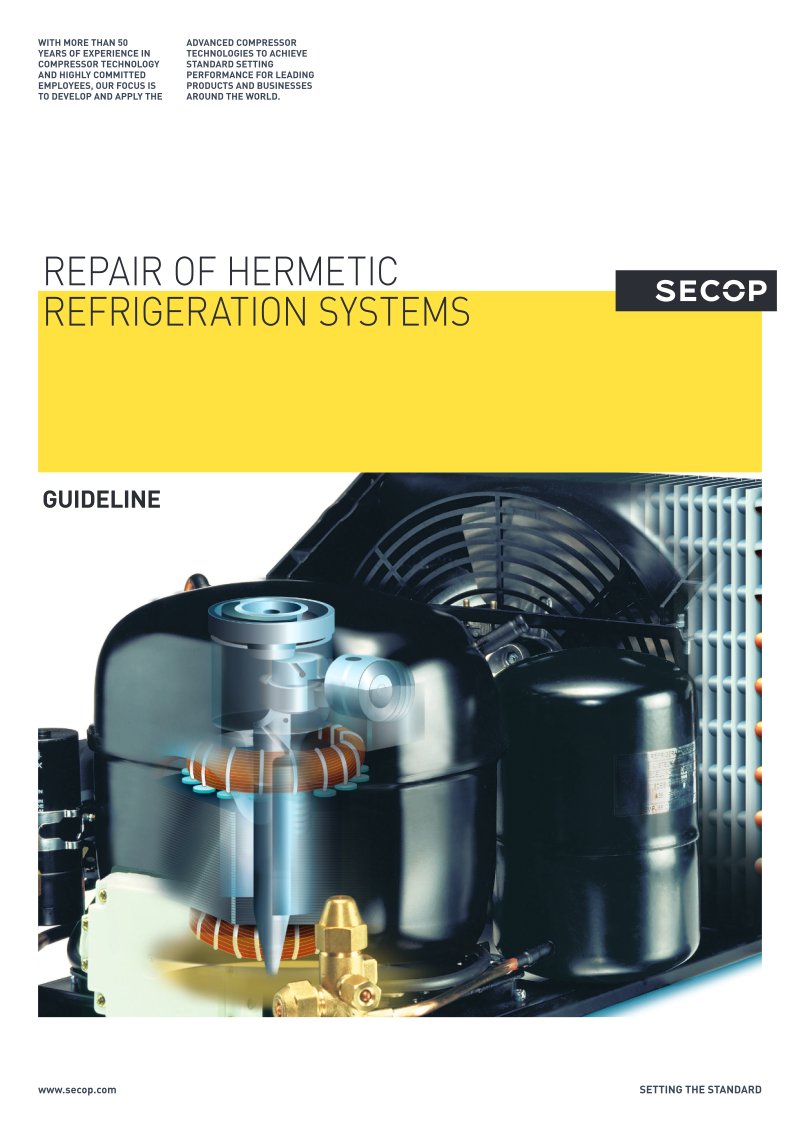
Repair of Hermetic Refrigeration Systems - Guideline
Comprehensive repair manual for sealed hermetic refrigeration systems from SECOP, providing technicians with methodical troubleshooting and repair procedures for commercial and industrial cooling equipment. Covers systematic fault diagnosis and location, proper system opening and inert-gas brazing techniques to maintain system integrity, filter drier replacement protocols, and evacuation procedures essential for moisture removal. Details refrigerant handling protocols and charging methods for multiple refrigerant types including R12, R134a, R502, and R404a, along with step-by-step guidance for refrigerant conversion and retrofitting between legacy and modern alternatives. Includes dedicated sections on compressor replacement, motor burnout diagnosis, and electrical circuit fault detection across PL, DL, TL, NL, and FR series compressor models. Extensive coverage of soldering and brazing practices, LokRing mechanical connections, vacuum pump selection and operation, and contamination remediation for systems exposed to moisture ingress. Incorporates mandatory safety protocols for handling flammable refrigerants R600a and R290 in sealed-system applications. A practical service manual and troubleshooting guide essential for anyone performing maintenance, repair, or retrofit work on hermetic refrigeration systems. Table of Contents: - General .... page 3 - Fault location .... page 4 - Replacement of thermostat .... page 5 - Replacement of electrical equipment .... page 6 - Replacement of compressor .... page 6 - Replacement of refrigerant .... page 6 - Rules for repair work .... page 8 - Opening the system .... page 8 - Brazing under an inert protective gas .... page 9 - Filter drier .... page 10 - Moisture penetration during repair .... page 11 - Preparation of compressor and electrical equipment .... page 11 - Soldering .... page 13 - LokRing® connections .... page 15 - Evacuation .... page 16 - Vacuum pump and vacuum gauge .... page 18 - Handling of refrigerants .... page 19 - Charging with refrigerant .... page 19 - Maximum refrigerant charge .... page 20 - Test .... page 20 - Leak test .... page 20 - Replacement of defective compressor .... page 21 - Preparation of components .... page 21 - Removal of charge .... page 21 - Removal of defective compressor .... page 21 - Removal of refrigerant residues .... page 21 - Removal of filter drier .... page 21 - Cleaning of solder joints and reassembly .... page 21 - From R12 to other refrigerants .... page 22 - From R12 to alternative refrigerant .... page 22 - From R12 to R134a .... page 22 - From R134a to R12 .... page 22 - From R502 to R404a .... page 22 - Systems contaminated with moisture .... page 23 - Low degree of contamination .... page 23 - High degree of contamination .... page 23 - Evacuation .... page 24 - Drying of compressor .... page 24 - Oil charge .... page 25 - Lost refrigerant charge .... page 26 - Burnt compressor motor .... page 27 - Oil acidity .... page 27 - Burnt system .... page 27 - Fault location on PL / DL / TL / NL / FR compressors .... page 28 - Fault location .... page 28 - Electrical quick check .... page 28 - Fault location - detectable faults .... page 29 - Check main and start winding .... page 29 - Check protector .... page 29 - Check relay .... page 29 - Check PTC .... page 29 - Fault location - table I .... page 30 - Fault location - table II .... page 31