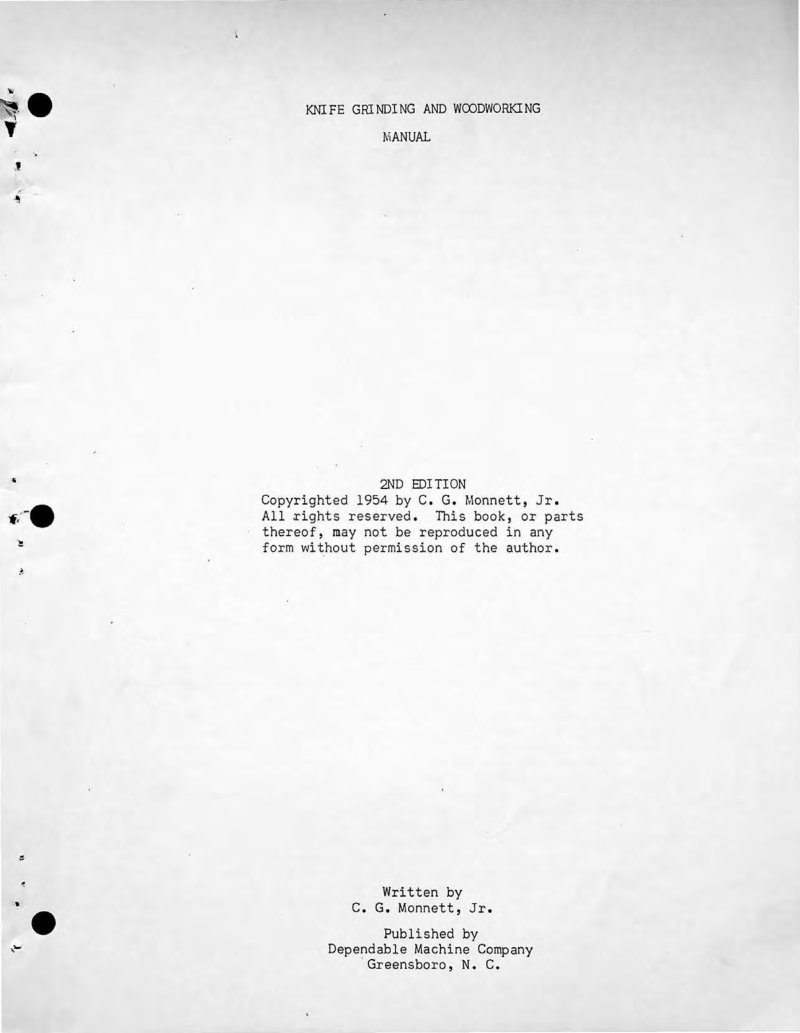
Knife Grinding and Woodworking Manual
Second edition workshop manual from Dependable Machine Company offering comprehensive guidance on knife grinding and woodworking fundamentals. This 182-page service manual covers the core principles of effective grinding practice and detailed equipment setup for any grinding room environment. Explores the critical role of the machine operator in achieving quality results, and provides in-depth technical information on grinding wheel construction—examining bond types, abrasive materials (including emery, aluminum oxide, silicon carbide, corundum, and diamond), grain sizing standards, and optimal wheel speeds for different applications. Also details the full range of grinding wheel profiles and standard dimensions, along with proven dressing and truing methods to maintain wheel performance. A practical reference for anyone working with grinding machinery and hand tool maintenance.
Table of Contents:
- I. INTRODUCTION
- II. ESSENTIALS FOR GOOD GRINDING
- A. Erection of Proper Grinding Room
- 1. Separate Building More Satisfactory
- 2. Large Well Lighted Room Needed
- 3. Solid Foundation or Floor Very Important
- 4. Should Have Independent Foundation for Machines
- 5. Machines Should Have Level Foundation
- B. Importance of Experienced Operator
- 1. Good Operator Most Economical
- 2. Poor Performance of Machines Often Due to Operator
- 3. Frequent Turn Over Of Operators Indicates Poor Machinery
- C. Improving Efficiency of The Grinding Room
- 1. Good Machinery Most Efficient and Economical
- 2. Several of the Machines Can Be Operated at the Same Time
- 3. Good Operator Will Request Necessary Machines
- 4. Grinding Room Must Be Free of Vibration
- 5. Best Efficiency Obtained From Machines Individually Motor Driven
- 6. Use Correct Grinding Wheels For Best Efficiency
- 7. Keep Machine Clean
- 8. Make Regular Inspections of Your Machine
- D. Burned Machinery
- 1. Rebuilding Burnt Machinery Not Usually Practical
- E. Use Proper Grinding Wheels
- III. COMPOSITION, CARE AND USE OF GRINDING WHEELS
- A. Composition of Grinding Wheels
- 1. Bond
- a. Vitrified
- b. Resinoid
- c. Rubber
- d. Shellac
- e. Silicate
- f. Metal
- 2. Abrasives
- a. Types of Abrasives
- 1. Emery
- 2. Aluminum Oxide
- 3. Silicon Carbide
- 4. Corundum
- 5. Diamond
- b. Grain Numbers
- c. Chart of Grain Size
- 3. Grade
- 4. Structure
- 5. Standard Grinding Wheel Shapes
- a. Dimensions of Standard Shapes
- b. Dimensions of Standard Faces
- B. Grinding Wheel Speeds
- 1. Correct Speed Necessary for Efficiency, Durability and Economy
- 2. Table of Straight Emery Wheel Speeds
- 3. Speed for Cup Wheel
- 4. Speed for Diamond Wheels
- C. Dressing and Truing Grinding Wheels
- 1. Hydro-Travl Grinders Have Built-In Wheel Dresser
- 2. Dress Grinding Wheels Lightly
Documentation must be downloaded on a computer (PC, Mac, or Linux).
Do not use a smartphone or tablet to download documentation; they generally lack sufficient memory capacity to handle large files, and few users know how to locate the download folder on these devices.
Once downloaded, you can use it right away and even print the pages you need, or use your smartphone in photo mode to translate into the language of your choice: Google Translate
Document Details
- Format
- Pages
- 182
- Size
- 29.2 MB
- Category
- Machine Tools