WIDELUX PANON - Service Manuals
4 manuals available for download
WIDELUX PANON represents a distinctive chapter in panoramic photography history, crafted for enthusiasts and professionals seeking to master swing-lens camera technology. Our comprehensive collection of technical documentation includes detailed user manuals, service guides, and repair resources available as PDF downloads, enabling you to maintain, troubleshoot, and optimize your equipment. Whether you're consulting an owner's manual for operational guidance or accessing workshop materials for maintenance procedures, these resources provide the technical foundation needed to keep your WIDELUX PANON panoramic camera in peak condition.
Widelux 35mm Panoramic Camera - Complete User Manual
Complete user manual in French for the Widelux 35mm panoramic swing-lens camera by PANON Camera Shoko Co., Ltd. This comprehensive guide walks you through operation and film loading, exposure settings and shooting techniques tailored to the camera's distinctive swing-lens design. You'll find detailed coverage of the Widelux's optical characteristics—including how horizontal lines distort and what causes banding artifacts—so you understand what to expect and how to work with these signature effects rather than fight them. The manual includes practical depth of field tables, model history and technical specifications, plus concrete film selection advice and guidance for scanning panoramic negatives. Beyond mechanics, you'll learn evaluation criteria and real-world tips for consistently getting strong results with this unique format, from composition strategies to exposure metering for the camera's full frame width.
Widelux 35mm Panoramic Swing-Lens Camera User Manual
Complete user manual in English for the Widelux 35mm panoramic swing-lens camera by PANON Camera Shoko Co., Ltd. This manual covers film loading, exposure control, and the camera's distinctive swing-lens operation, along with practical shooting techniques and depth of field tables. You'll find detailed guidance on film selection, achieving sharp well-exposed panoramic images, and understanding the camera's characteristic horizontal line distortion and banding phenomena—essential knowledge for working effectively with these optical traits. Includes model history, technical specifications, scanning advice, and evaluation criteria to help you achieve the best results from this uniquely mechanical camera. Table of Contents: 1. INTRODUCTION TO THE WIDELUX - 1.1 A unique principle: the swing lens - 1.2 A precision mechanism from the 1950s - 1.3 Technical specifications - 1.4 Model history - 1.5 The Widelux in history 2. DESCRIPTION OF CONTROLS - 2.1 Finger clearance zones - 2.2 The viewfinder 3. LOADING THE FILM - 3.1 Opening and inserting the cartridge - 3.2 Threading the leader - 3.3 Closing and preparation - 3.4 First calibration exposure 4. EXPOSURE SETTINGS - 4.1 Selecting the shutter speed - 4.2 Setting the aperture - 4.3 Depth of Field Table (Widelux F7) 5. SHOOTING - 5.1 Holding the camera - 5.2 Using the spirit level - 5.3 Shooting sequence - 5.4 Special shooting techniques - 5.5 Rewinding the film 6. UNDERSTANDING THE WIDELUX'S CHARACTERISTICS - 6.1 Horizontal line distortion at the edges - 6.2 The "banding" phenomenon - 6.3 Why fast speeds are more demanding - 6.4 Optical limitations when shooting into the light - 6.5 Why modern scanners reveal more imperfections - 6.6 Restoration has its limits 7. HOW TO PROPERLY EVALUATE A WIDELUX 8. TIPS FOR GOOD RESULTS - 8.1 Film choice - 8.2 Managing light - 8.3 Framing and composition - 8.4 Scanning Widelux films 9. SUMMARY OF ESSENTIAL RULES
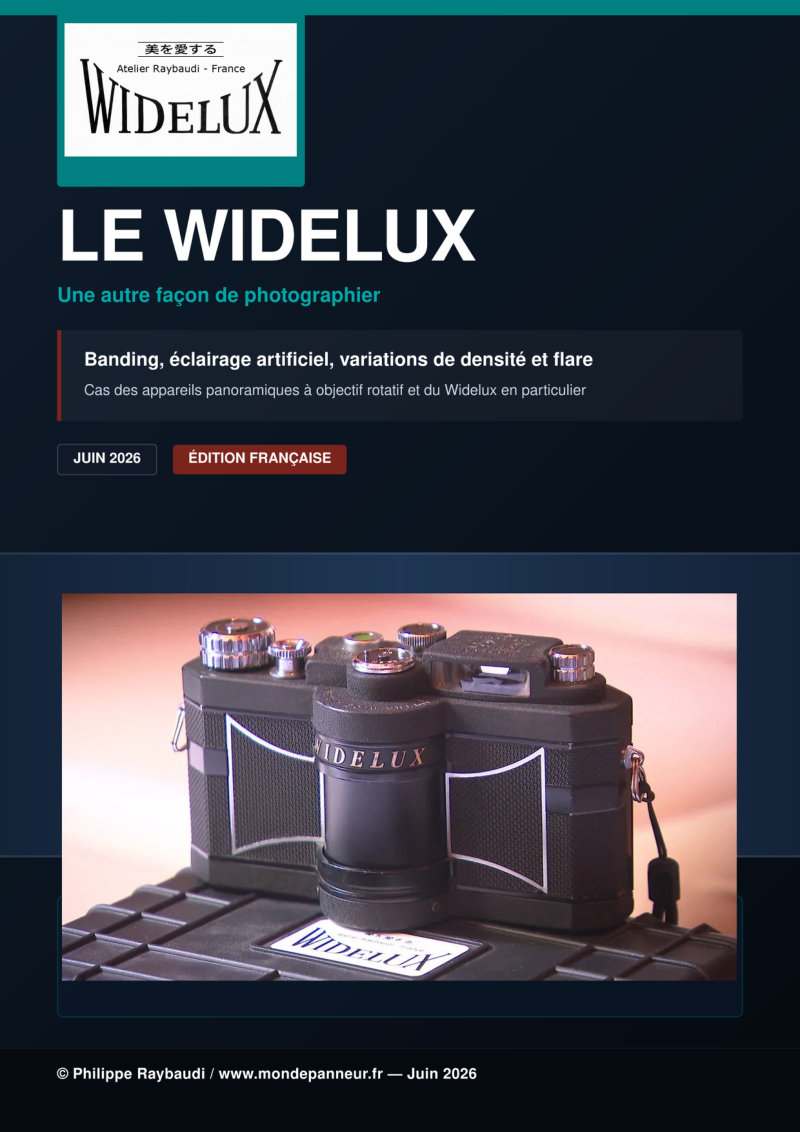
Widelux: Banding, Flare and Diagnostics
Technical guide, in French, analyzing density banding, flare, and exposure variations in panoramic cameras with rotary lens mechanism, particularly the Widelux. Covers theater and stage lighting, night scenes, interiors, LED/fluorescent/halogen/HMI lighting, low-contrast outdoor conditions. Distinguishes issues related to light, mechanics, optics, film, development, and digitization. Includes diagnostic protocols and practical recommendations.
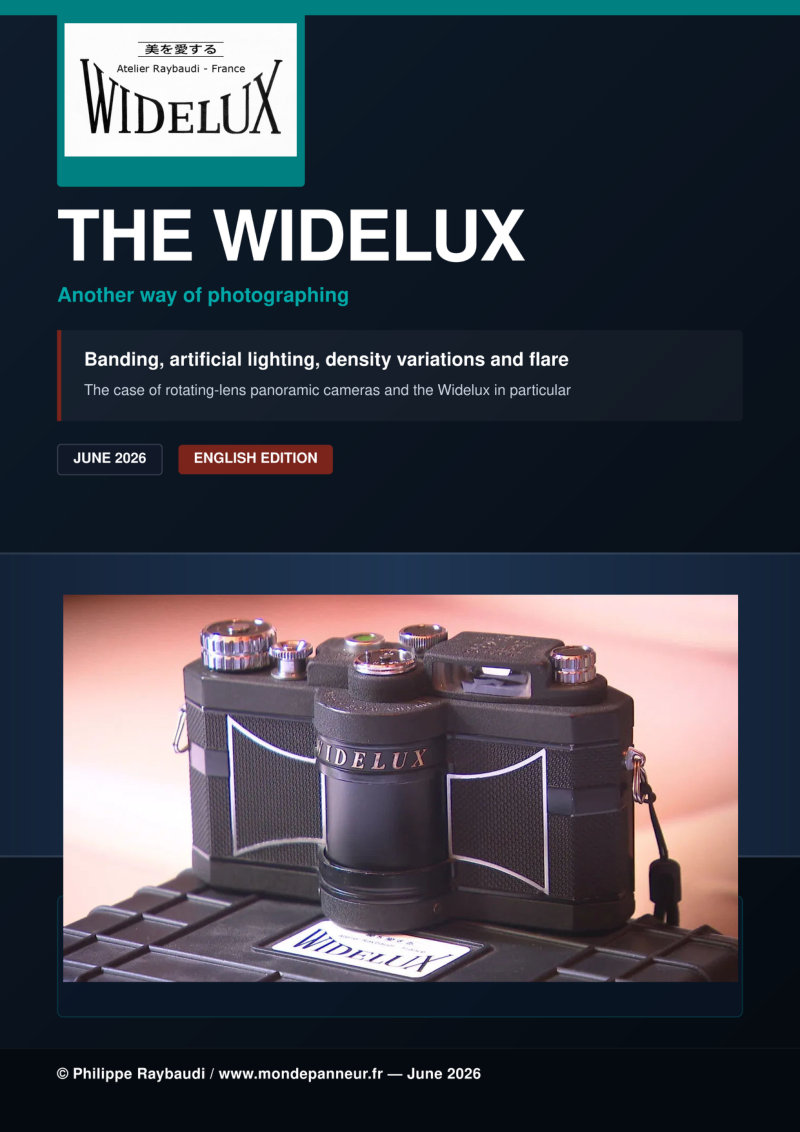
Widelux: Banding, Flare and Diagnostics Guide
Technical guide, in English, analyzing density banding, flare, and exposure variations in rotating-lens panoramic cameras, specifically the Widelux. Covers artificial lighting (theater, concert, LED, fluorescent, halogen, HMI, discharge), natural light situations, mechanical causes, optical effects, film processing, and scanning issues. Includes diagnostic protocols, visual signatures identification, and practical recommendations for troubleshooting image defects. Table of Contents: - The problem: a camera that builds the image over time - Banding: definition, families and visual signatures - Artificial lighting: theatre, performance venues, interiors, night - Why LEDs and dimmers pose a particular problem - Banding in natural light and uniform surfaces - Mechanical banding: governor, friction, spring, lubrication - Flare, veiling flare and intense light sources - Processing, scanning and false diagnoses - Test protocols and practical recommendations - Conclusion - Quick diagnostic grid - Bibliography and technical sources - Further developments and practical cases - Theatre and performance venues: detailed analysis - Domestic interiors, museums, churches, restaurants - Night scenes and urban lighting - Sun, backlight and very intense point sources - Uniform surfaces: sky, snow, desert, sea, fog - Effect of the selected speed - How to document a defect - Recommendations table by situation - Operational synthesis