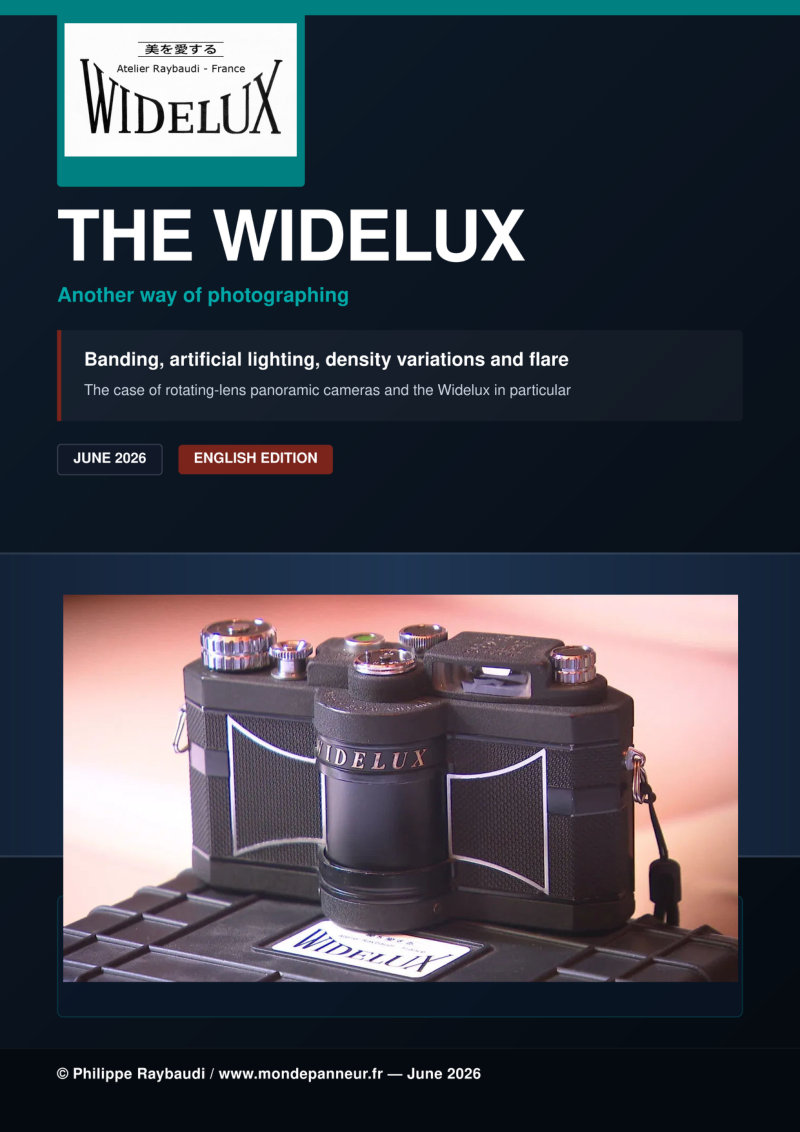
Widelux: Banding, Flare and Diagnostics Guide
Technical guide, in English, analyzing density banding, flare, and exposure variations in rotating-lens panoramic cameras, specifically the Widelux. Covers artificial lighting (theater, concert, LED, fluorescent, halogen, HMI, discharge), natural light situations, mechanical causes, optical effects, film processing, and scanning issues. Includes diagnostic protocols, visual signatures identification, and practical recommendations for troubleshooting image defects.
Table of Contents:
- The problem: a camera that builds the image over time
- Banding: definition, families and visual signatures
- Artificial lighting: theatre, performance venues, interiors, night
- Why LEDs and dimmers pose a particular problem
- Banding in natural light and uniform surfaces
- Mechanical banding: governor, friction, spring, lubrication
- Flare, veiling flare and intense light sources
- Processing, scanning and false diagnoses
- Test protocols and practical recommendations
- Conclusion
- Quick diagnostic grid
- Bibliography and technical sources
- Further developments and practical cases
- Theatre and performance venues: detailed analysis
- Domestic interiors, museums, churches, restaurants
- Night scenes and urban lighting
- Sun, backlight and very intense point sources
- Uniform surfaces: sky, snow, desert, sea, fog
- Effect of the selected speed
- How to document a defect
- Recommendations table by situation
- Operational synthesis
Documentation must be downloaded on a computer (PC, Mac, or Linux).
Do not use a smartphone or tablet to download documentation; they generally lack sufficient memory capacity to handle large files, and few users know how to locate the download folder on these devices.
Once downloaded, you can use it right away and even print the pages you need, or use your smartphone in photo mode to translate into the language of your choice: Google Translate
Document Details
- Format
- Pages
- 14
- Size
- 5.7 MB
- Category
- Photography