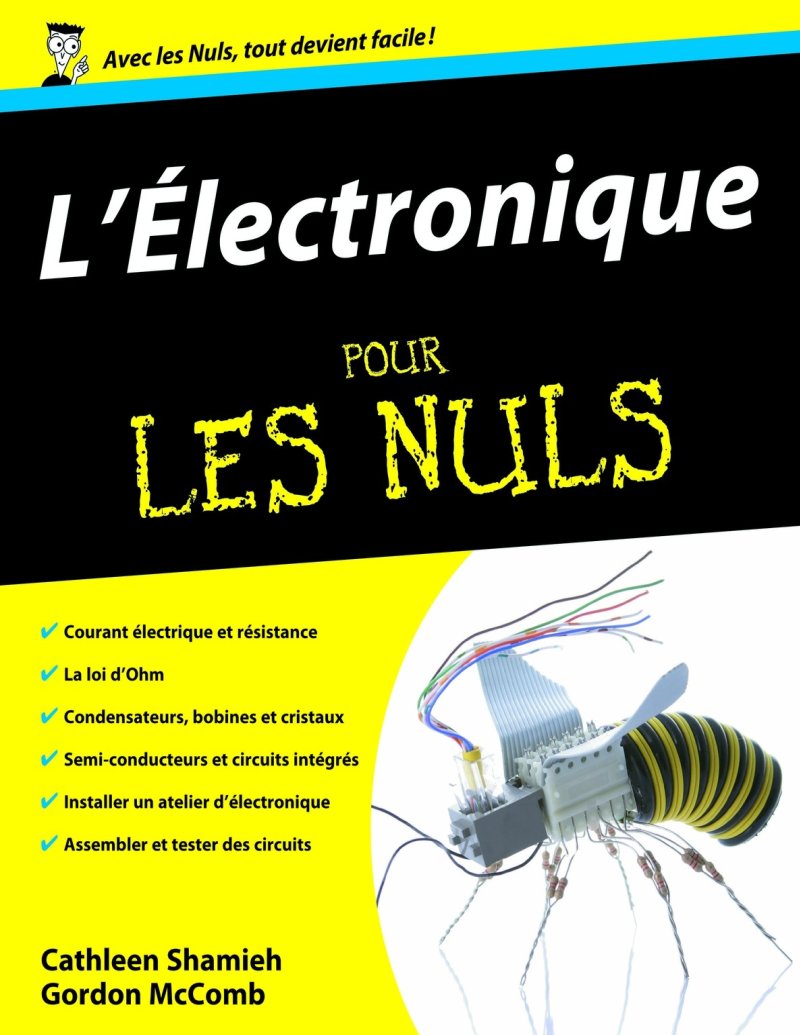
Electronics For Dummies - Complete Guide
A comprehensive guide to electronics fundamentals and practical applications covering electrical current, resistance, and Ohm's law through to semiconductors, transistors, and integrated circuits. This second edition walks readers through capacitors, inductors, and crystals with clear explanations suited to hands-on learners. The manual includes detailed sections on workshop setup and safety protocols, soldering techniques, and circuit assembly and testing methods. You'll find practical exercises throughout, guidance on component selection for different applications, and the foundation needed to understand how electronic devices actually work. Whether building your first functional circuit or troubleshooting component behavior, this guide provides the technical knowledge and step-by-step instruction beginners need to move confidently from theory to practice.
Table of Contents:
- Title Page .... page 1
- Copyright Page .... page 4
- Introduction .... page 15
- About This Book .... page 15
- Why Electronics? .... page 16
- Preconceived Ideas .... page 17
- Safety First .... page 18
- What You Will Find in This Book .... page 18
- First Part: The Basics of Electronics .... page 19
- Second Part: Getting Your Hands Dirty .... page 19
- Third Part: From Theory to Practice .... page 20
- Fourth Part: The Part of Tens .... page 20
- Icons Used in This Book .... page 20
- First Part - The Basics of Electronics .... page 6
- Chapter 1 - Electronics, What Is It and What Is It For? .... page 6
- Electronics, What Is It Exactly? .... page 6
- Electric Current, What Is It? .... page 6
- The Charge of Electrons .... page 6
- When Electrons Let Themselves Be Conducted .... page 6
- What Makes Electrons Run? .... page 6
- Exploiting Electrical Energy .... page 6
- Electrical Energy: It's All in the Movement .... page 6
- For Electrons to Reach Their Destination .... page 6
- It's Amazing What You Can Make Electrons Do! .... page 6
- Creating Good Vibrations .... page 6
- Seeing Is Believing .... page 6
- Sensing and Reacting .... page 6
- Controlling Movement .... page 6
- Solving Problems .... page 6
- Communicating .... page 6
- Chapter 2 - Manipulating Electric Current to Obtain a Particular Effect .... page 6
- How to Obtain Electrical Energy? .... page 6
- Direct Current Supplied by a Battery .... page 6
- Alternating Current Produced by a Power Plant .... page 6
- Transforming Light into Electricity .... page 7
- The Right and Wrong Direction: Real Electron Flow and Conventional Current Direction .... page 7
- Study of a Simple Circuit with a Light Bulb .... page 7
- Controlling Electric Current Using Basic Components .... page 7
- How to Control Current? .... page 7
- Active and Passive Components .... page 7
- Series and Parallel Connections .... page 7
- Series Connections .... page 7
- Parallel Connections .... page 7
- Combined Circuits .... page 7
- Creating Electronic Systems .... page 7
- A Sound in the Air .... page 7
- When Electrons Form Images .... page 7
- Chapter 3 - First Steps Toward Resistance .... page 7
- Resisting Current .... page 7
- Resistors: Passive but Powerful .... page 7
- What Are Resistors For? .... page 7
- Choosing a Fixed or Variable Resistor .... page 7
- Reading Fixed Resistor Specifications .... page 7
- Potentiometers .... page 7
- The Stated Power Is Not Indicated .... page 7
- Combining Resistors .... page 7
- Resistors in Series .... page 7
- Resistors in Parallel .... page 7
- Combining Series and Parallel Resistor Connections .... page 7
- Obeying Ohm's Law .... page 7
- Current Flowing Through a Resistor .... page 7
- It's Always Proportional! .... page 7
- One Law, Three Equations .... page 7
- Using Ohm's Law to Analyze Circuits .... page 7
- Calculating Current Intensity Through a Component .... page 7
- Calculating Voltage Across a Component .... page 7
- Calculating a Resistance .... page 7
- What Is Ohm's Law Really For? .... page 7
- Analyzing Complicated Circuits .... page 7
- Designing and Modifying Circuits .... page 7
- The Power of Joule's Law .... page 7
- Using Joule's Law to Choose Components .... page 7
- Joule and Ohm: The Ideal Pair .... page 7
- Circuits and Resistors, Practical Work .... page 7
- Chapter 4 - Capacitors Step by Step .... page 7
- Capacitors, Electrical Energy Reservoirs .... page 7
- Charging and Discharging Capacitors .... page 8
- Opposition to Voltage Variations .... page 8
- Alternating Current, An Alternative .... page 8
- What Are Capacitors For? .... page 8
- Capacitor Characteristics .... page 8
- What Charge Can a Capacitor Store? .... page 8
- Checking Maximum Working Voltage .... page 8
- Choosing the Right Type of Capacitor (Dielectric) .... page 8
- Size and Shape of Capacitors .... page 8
- Capacitor Polarity .... page 8
- Reading Capacitor Specifications .... page 8
- Variable Capacitance .... page 8
- Parallel Capacitor Assembly .... page 8
- Series Capacitor Assembly .... page 8
- What Is Capacitive Reactance? .... page 8
- Using Ohm's Law for Capacitive Reactance .... page 8
- Combining with Resistors .... page 8
- A Matter of Timing .... page 8
- Calculating Time Constants of an RC Circuit .... page 8
- Making a Timer .... page 8
- Selecting Frequencies with Simple RC Filters .... page 8
- The Low-Pass Filter .... page 8
- The High-Pass Filter .... page 8
- Cutting Frequencies Like Butter .... page 8
- Filtering Frequency Bands .... page 8
- Simple Capacitive Circuits, Practical Work .... page 8
- Chapter 5 - Coils and Crystals .... page 8
- Cousins That Embrace: Magnetism and Electricity .... page 8
- Magnets and Flux Lines .... page 8
- Producing a Magnetic Field with Electricity .... page 8
- Inducing a Current Using a Magnet .... page 8
- The Inductor, a Very Magnetic Coil .... page 8
- Measuring Inductance .... page 8
- Opposition to Current Variations .... page 8
- Alternating Current, or When the Alternative Becomes Paralyzing .... page 8
- Inductive Reactance, What Is It? .... page 8
- Applying Ohm's Law to Inductive Reactance .... page 8
- Everything Depends (Again) on Frequency .... page 8
- The Role of Inductors in Circuits .... page 8
- Isolating and Shielding Inductors .... page 8
- Reading Inductance Value .... page 8
- Combining Shielded Inductors .... page 8
- Filtering Signals with Inductors .... page 8
- Calculating RL Time Constant .... page 8
- And Now, Impedance! .... page 8
- Radio Broadcasting .... page 9
- Resonance and RLC Circuits .... page 9
- Crystals for Better Resonance .... page 9
- Following the Thread of Coils: Transformers .... page 9
- Interaction Between Unshielded Coils .... page 9
- Isolating Circuits from a Power Source .... page 9
- Raising or Lowering Voltage .... page 9
- Chapter 6 - The Vast World of Semiconductors .... page 9
- When Being a Conductor Becomes a Passing State .... page 9
- Doping Semiconductors .... page 9
- Creating Components by Combining N-Type and P-Type .... page 9
- A Junction Diode .... page 9
- Diodes and Polarization .... page 9
- When Current Passes Through the Diode .... page 9
- The Value of a Diode .... page 9
- Identifying Diodes .... page 9
- Which Way Does It Connect
Documentation must be downloaded on a computer (PC, Mac, or Linux).
Do not use a smartphone or tablet to download documentation; they generally lack sufficient memory capacity to handle large files, and few users know how to locate the download folder on these devices.
Once downloaded, you can use it right away and even print the pages you need, or use your smartphone in photo mode to translate into the language of your choice: Google Translate
Document Details
- Format
- Pages
- 437
- Size
- 5.6 MB
- Category
- DIY & Home Improvement